The results of the US midterms on November 3 delivered a resounding victory for the Democrats, and a major loss for US president Donald Trump and the Republican party.
Gaining control of the Senate and the House of Representatives has emboldened the Democrats, giving them a renewed sense of political legitimacy and a mandate to pursue their agenda. But will this shift translate into meaningful changes in US climate change policy?
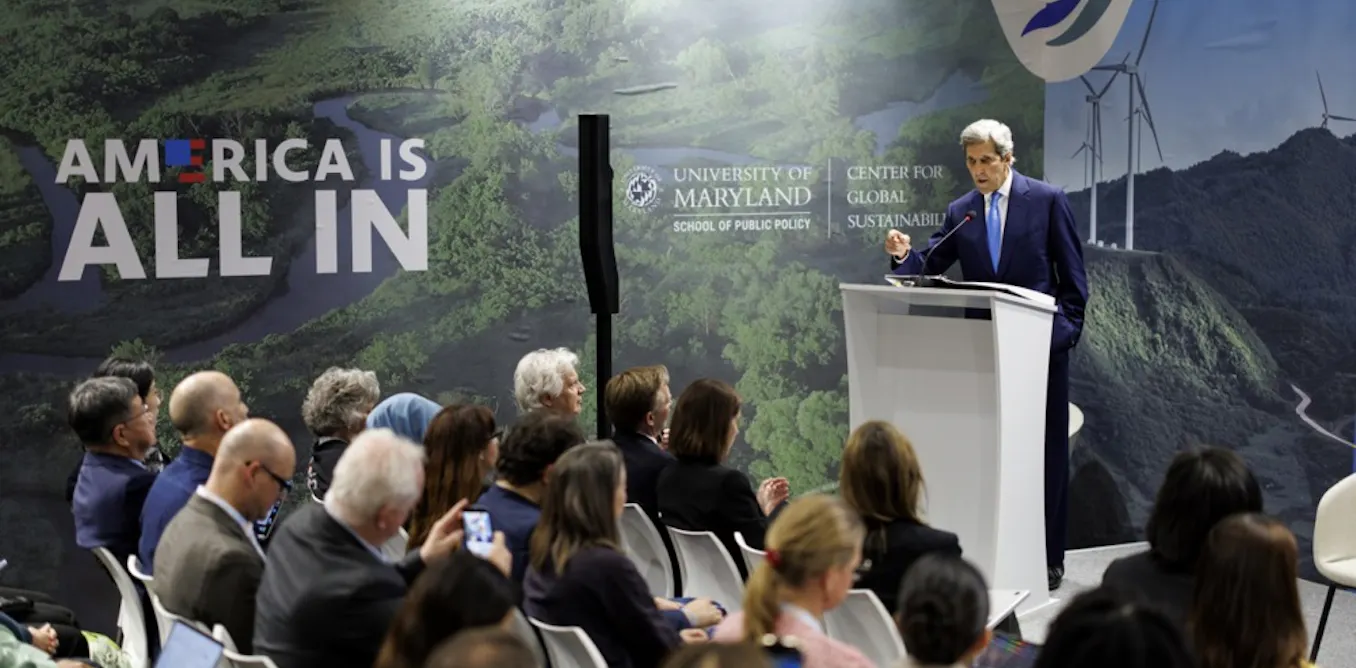
The Democratic sweep will change the political dynamics around US climate policy and how the country cooperates with the international community on this issue. Although there was no official US presence at the 2025 Cop conference, held in Brazil, a coalition of 100 local US leaders, including governors, mayors and other top city and state officials, attended as part of the US Climate Alliance. Former US vice-president Al Gore, and former US secretary of state John Kerry are part of an unofficial US group at the 2026 gathering.
Kerry said in a speech there: “Americans are committed to taking back their future, and we will build and rebuild our partnerships as we do that.”
Being on the ground at Cop is important. As the US has a decisive role to play in global climate policy, sending a non-official coalition signals that many Americans are still working to combat climate change.
Trump has repeatedly stated that climate change is a hoax and refused to attend the Cop31 climate talks being held in Turkey. But 20 Democratic members of Congress will be attending, although they have been denied official state department funding for the trip.
During the first and second Trump administrations, the US has been an outlier among wealthy countries when it comes to fighting climate change. Trump has actively backed the use of fossil fuels, undermining clean energy projects, and rolled back legislation that stipulated emission standards for vehicles.
Trump also weakened greenhouse gas reporting requirements and methane regulation. Then in February 2026, the Trump administration rescinded the Environmental Protection Agency’s 2009 finding that greenhouse gases threaten the health and welfare of the public, which had regulated the emissions from new cars and other vehicles. This had provided the legal foundation for regulation under the Clean Air Act.
On the international front, Trump was equally determined to undermine global efforts to fight climate change. Famously, he withdrew from the Paris agreement, part of a global initiative to address climate change, and refused to attend Cop summits. But the Democrats’ seismic midterm win may be a sign of optimism for those fighting to address climate change.
Data centres are big issue
The biggest issues of the midterms were affordability, corruption and the Iran war, but issues related to fighting climate change were also on voters’ list. There is growing concern about data centres. As many as 56% of US voters felt that data centres and AI were either a major or even crucial factor in influencing who they voted for, with only 13% saying it was not a factor at all.
Data centres require millions of gallons of water for cooling systems, and this is expected to rise to 73 billion litres of water a year by 2028. Over half of planned AI facilities in the US will be situated in areas that have significant water shortages or drought conditions.
After the midterms, Zoe Lofgren, a Democrat, is likely to become the chair of the House of Representatives’ committee on science, space and technology once the new session starts in January. She wants to tackle the administration’s “climate denialism”.
Lofgren’s leadership, along with new Democratic members of the committee, may offer it more power to reverse some of the Trump administration’s changes to science policy.
However, the Democrat midterm wins will not mean that the US is automatically back at the negotiating table at Cop nor that the US will be able to rejoin the Paris Accords while Trump is president. Trump still has the power to make these decisions and can continue to keep the US out of international climate initiatives, regardless of who controls Congress. The US Constitution says nothing about withdrawing from treaties, which creates uncertainty for what the Senate’s role might be.
The election, however, does signal that there is considerable domestic opposition to his approach. And while Congress has not passed follow-up legislation prohibiting presidential withdrawal from the United Nations Framework Convention on Climate Change (UNFCCC), it has continued to fund several UNFCCC initiatives. During the Biden administration, the US significantly increased climate finance from US$1.5 billion (£1.1 billion) a year in 2021 to US$9.5 billion in 2023.
Democrats could also push back on Trump’s current policies, using their power to hold hearings, investigate the administration’s dismantling of climate programmes and challenge cuts to scientific research. The Democrats can also use the power of Congress’s control of spending to protect or restore funding to some of these environmental initiatives.
They could also try to introduce legislation that reinstates some of the clean energy initiatives that had been implemented in past administrations to strengthen emissions standards and support clean energy. The big issue, however, is that Trump has made it clear that he is going to be very active in using his veto power, and without a two-thirds majority in Congress, the Democrats will not be able to override this.
What does this mean globally?
What this all means is that the world cannot expect the US to be a reliable and constructive partner at Cop with Trump still in power. Trump will probably continue to forge ahead with expanding fossil fuel production, while weakening international climate cooperation, even if the electorate disapproves of these policies.
Ironically, Trump’s greatest contribution to the fight against climate change was his initiation of the war with Iran, which helped to cut global fossil fuel carbon dioxide emissions by 0.4% due the closure of the Strait of Hormuz. But climate scientists note this is not a long-term solution.
While the Democrats’ electoral victory offers a glimmer of hope for renewed climate action, both domestically and internationally, restoring US climate leadership will take time, especially while Trump remains in power.