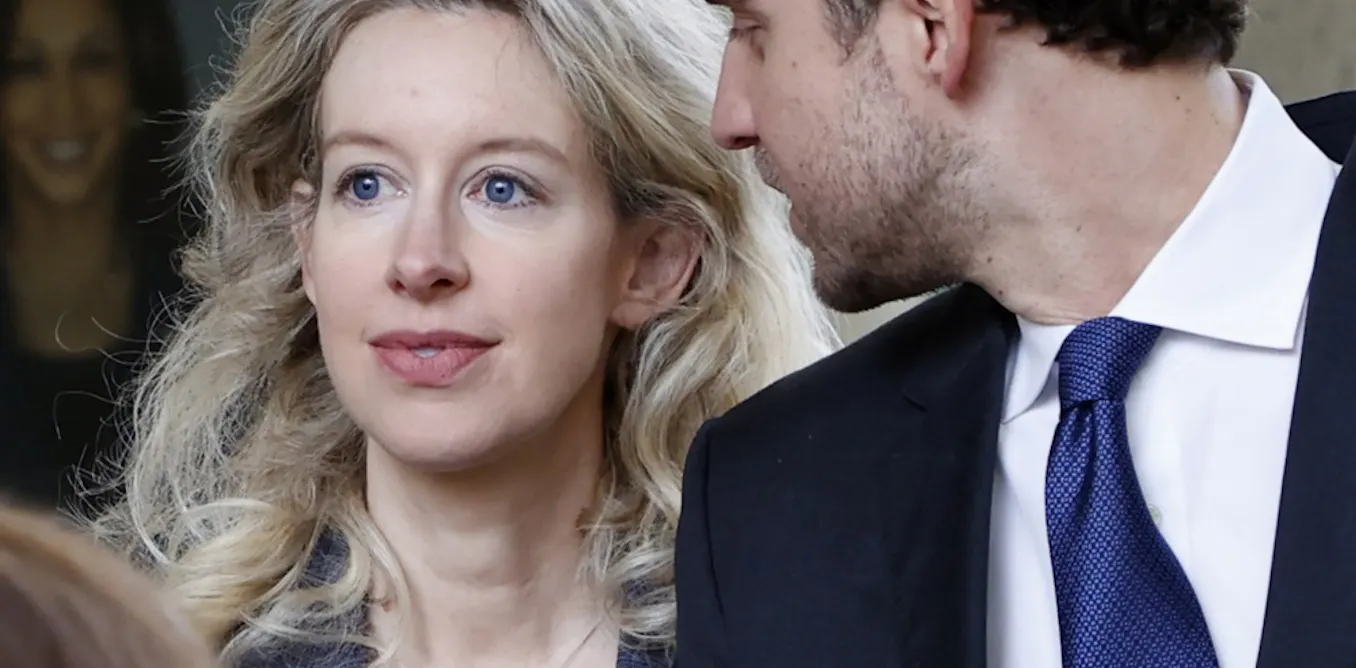
Despite the countless books, podcasts, TV miniseries and documentaries, people continue to be fascinated by the fall of Elizabeth Holmes and her health-tech startup Theranos. We are now being offered a new insight into the founder through the much-hyped documentary, You Can See Everything.
The initial drama of the documentary takes places 34 days before Holmes started her 11-year prison sentence for investor fraud in 2023. In our research, we examined how Holmes was presented across promotional materials, tweets, talks and interviews over the ten year period from her initial appearance on the public stage in 2013 to the same period in which the documentary begins.
Valued at around US$9 billion (£7 billion) at its peak in 2014, Theranos claimed to have built a device that could run hundreds of lab tests from just a few drops of blood. Holmes and co-founder Sunny Balwani hid that the device could not in fact do what they said, leading to its 2018 shutdown and their convictions for investor fraud (and, in Balwani’s case, defrauding patients as well).
For many, the fascination in Holmes’s story lies in the hubris and deception of this young woman who set out to upend the multi-billion dollar diagnostic industry. But popular perspectives on Holmes obscure something important about how we view entrepreneurs, who we celebrate (or vilify) and whose interests this serves. This is something our research explores.
A highly sellable female entrepreneur
In our analysis, we found that gendered stereotypes helped create an attractive female narrative around Theranos and Holmes between 2013 and 2015 that served (predominantly male) investor interests.
Holmes was introduced as a very specific kind of woman entrepreneur – confident, ambitious, authoritative. The prominent venture capitalist Tim Draper, who made his name backing companies like Tesla and was an early investor in Theranos, praised what he saw as Holmes’s entrepreneurial instincts in 2014. He said she was the first entrepreneur he know who kept quiet about her business “so that the competition wouldn’t get a chance to start … She had a winner and knew it”.
In 2015, Theranos board member and longtime Holmes supporter former US secretary of state Henry Kissinger talked about her as combining “fierce and single-minded dedication with great charm”.
Much was also made of her looks, with the media often noting she was a “young, blond, and blue-eyed” woman. She was a refreshing change from the usual men the industry pinned all its hopes on.
Holmes did present a highly sellable vision of a new Silicon Valley that welcomed and celebrated female entrepreneurs. In her 2019 book The Code: Silicon Valley and the Remaking of America, tech historian Margaret O’Mara noted that Holmes’s rise coincided with growing public scrutiny of Silicon Valley’s lack of diversity, and the “tech-bro” homogeneity of the early-to-mid 2010s. At the time, the Valley was also beset by high profile gender discrimination cases.
For investors, Holmes was an attractive answer to a media problem the tech industry had and the media coverage of her rise certainly helped counter some of critics of the Valley’s “brotopia”.
But Holmes’s brand of female founder was not totally new and this also served investors. In many articles she was portrayed as the female reincarnation of the stereotypical “tech bro” – a Mark Zuckerberg with a heart or a Steve Jobs with a social consciousness.
Then there was her intentional self styling, which the media played up as symbols central to her status as a female tech-visionary. Holmes’s signature black turtle necks seemed to be a homage to the uniform of Jobs, who regularly wore an Issey Miyake black turtleneck. She was asked about it again and again, admitting in an interview with Glamour that she owned 150 of them.
Holmes’s founder uniform combined with the fact that she had dropped out of university to pursue her vision, like Jobs, Zuckerberg and Bill Gates, gave her many of the recognisable characteristics of a successful tech founder. She was like all these visionaries but with the added bonus of being a woman. This portrayal fed straight into investor interests by making Holmes at once both familiar and novel, helping her company Theranos’s value to climb to unprecedented heights.
However, when things started to turn sour, our research found that much less flattering gendered stereotypes were quickly deployed. These narratives framed Holmes’ downfall as female weakness in order to protect powerful men.
An ousted ‘villain’
Holmes was vilified, not only as a failed entrepreneur, but also as a seductress who had used specifically female charms to lead competent men astray.
According to Rolling Stone, she “lured” male investors into her fraudulent schemes. Meanwhile, the Evening Standard reported her as having “wooed” the men on her board to do her bidding. Financial journalists described how Holmes “dazzled” normally sober leaders at supermarket chains Walgreens and Safeway who then invested in her scheme.
Holmes’s board of directors – once portrayed as the “most illustrious board in US corporate history” – along with the other powerful men she was seen as having duped could now be presented as innocent victims of malicious female magic.
For investors, this villification of Holmes could help them spin their own narratives in order to preserve public trust in their abilities. They could argue that her monstrous supernatural abilities to bamboozle and manipulate were too strong for them to overcome. In this media framing, the fact that investors appeared not to have conducted basic due diligence before investing hundreds of millions of dollars was neither their fault nor a reflection of their real talent for investment. They were simply good men who wanted to help people but had been fooled by a woman playing on an emotional blind spot. They were credulous rather than gullible.
To be clear, we don’t excuse Holmes or seek to diminish the seriousness of what she did. But her story tells us something interesting about the wider system surrounding tech entrepreneurs, and how we can remain blind to the ways capital interests can fuel – and exploit – popular and idolised archetypes.
You Can See Everything provides a new intimate portrait of Holmes, which will add, change or warp ideas we already have about her. But we also need to turn the focus back onto ourselves and think about the ways in which we idolise or judge people in her position – and the gendered stereotypes we would rather not admit to holding.