“DART made a really, really large mess. However, we didn’t really know what kind of mess.”
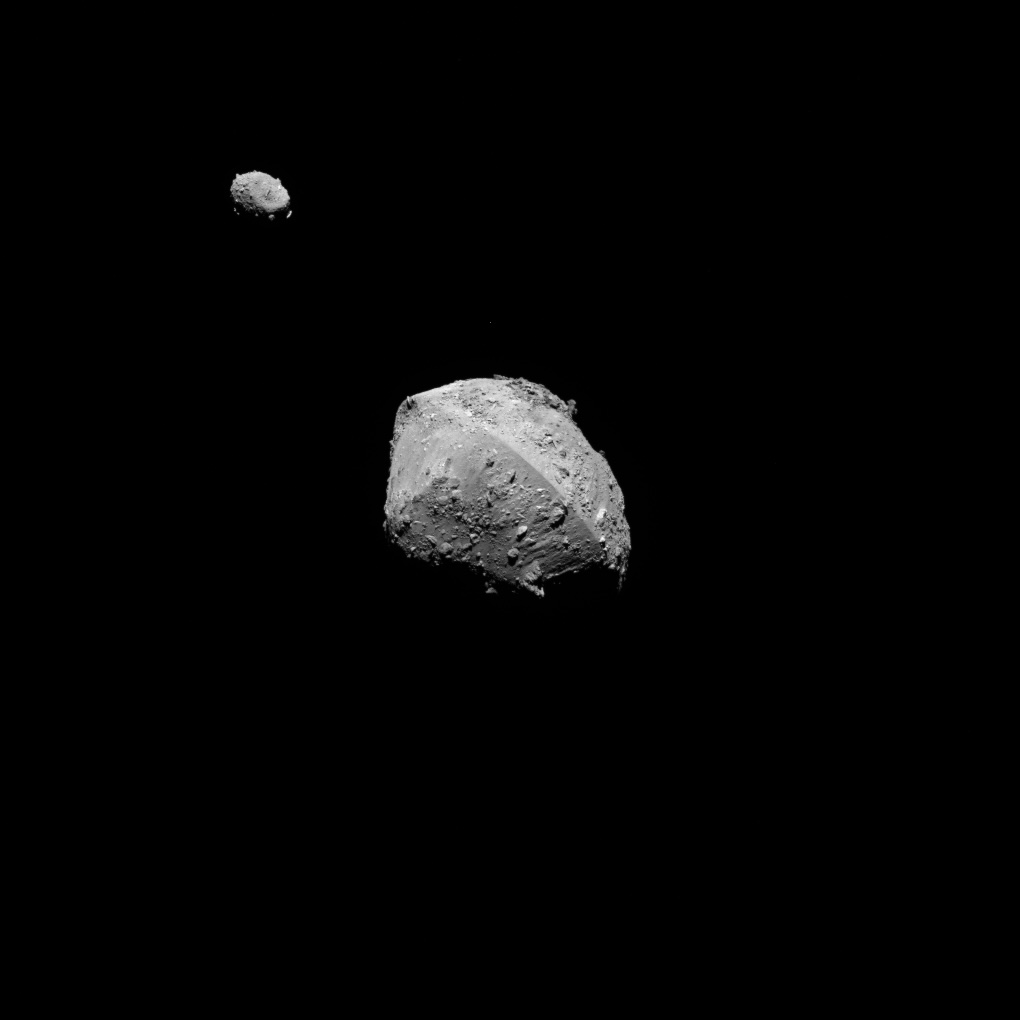
Four years ago, NASA dispatched a small spacecraft on a suicide mission to show how humanity might deflect an asteroid on a collision course with Earth. The first-of-its-kind experiment worked beautifully as the solar-powered space probe slammed into asteroid Dimorphos, permanently altering its trajectory.
Using telescopes, astronomers measured changes in the orbit of Dimorphos around a larger asteroid companion named Didymos in the aftermath of NASA’s Double Asteroid Redirection Test (DART) mission. The spacecraft released some 10 billion joules of energy as it impacted Dimorphos in September 2022 at more than 13,700 mph (6.14 kilometers per second), shortening the asteroid’s 12-hour orbit around Didymos by about 33 minutes, 25 times the most conservative expectation.
But scientists could only learn so much from DART. The collision destroyed the spacecraft, as expected. DART recorded images as it took aim on Dimorphos, but only faraway telescopes and a small CubeSat that briefly detected the impact flash could see what happened next.
“We knew right away that the impact was successful, that DART made a really, really large mess,” said Sabina Raducan, a planetary scientist at the International Space Science Institute in Bern, Switzerland. “However, we didn’t really know what kind of mess. We were still missing pieces of the puzzle.”
Following up
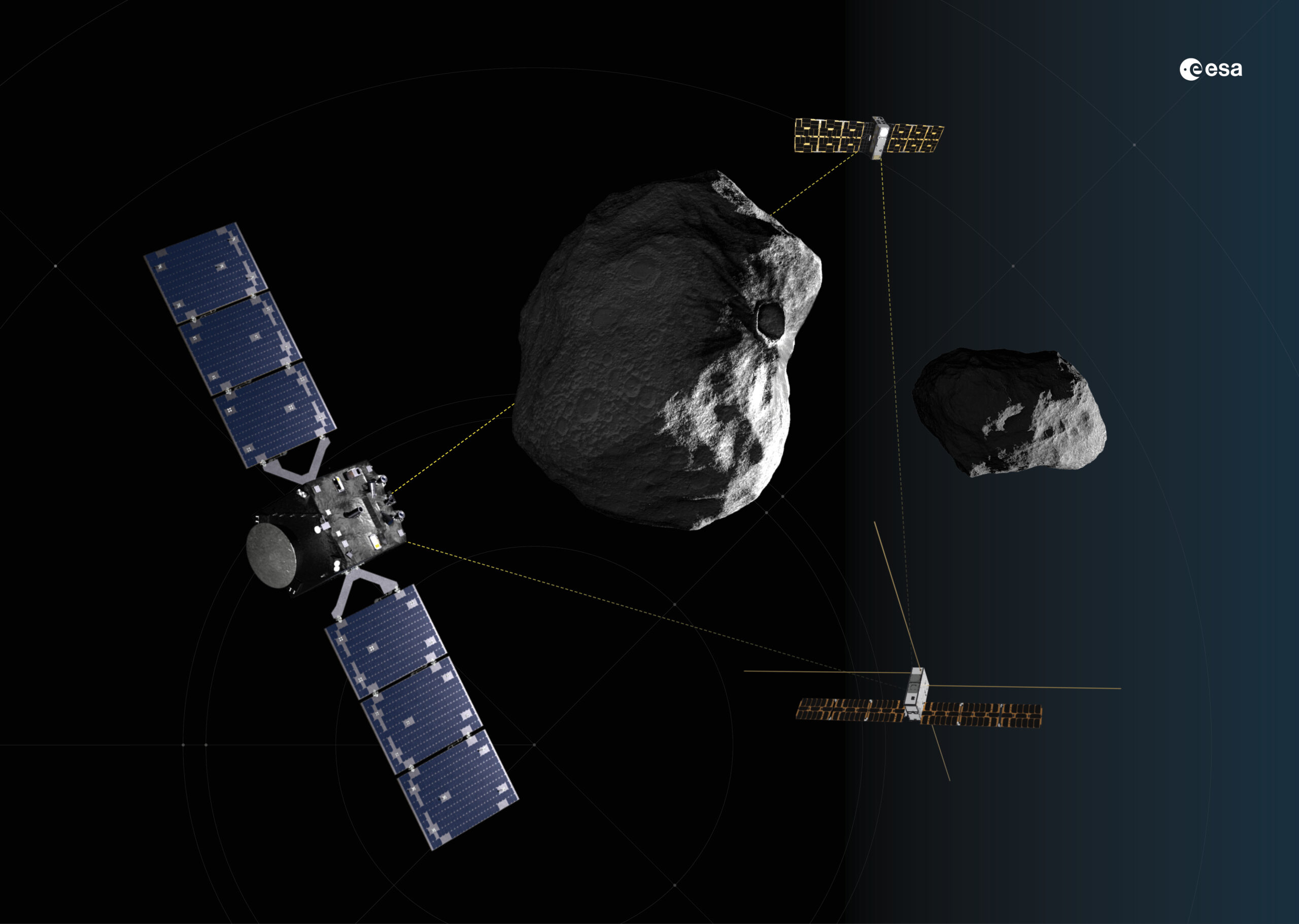
The European Space Agency’s Hera spacecraft recently arrived in the vicinity of Didymos and Dimorphos after a two-year journey from a launch pad in Florida. On Wednesday, ESA released Hera’s first views of the scar left by DART on Dimorphos. The images show the car-sized impactor carved out a crater the size of a stadium, nearly as big as Dimorphos itself, a rugged chunk of extraterrestrial rock measuring about 500 feet (151 meters) across.
Mission planners selected Didymos and Dimorphos for the deflection experiment because they are similar to many near-Earth asteroids, but there’s no risk of them striking our home planet. Scientists weren’t sure what Hera would find when it got to the double asteroid, currently orbiting the Sun about 120 million miles (193.5 million kilometers) from Earth.
“I would say we had two kinds of predictions: either we made a crater, or we reshaped the asteroid,” said Patrick Michel, Hera’s principal investigator from Côte d’Azur Observatory in Nice, France. “In fact, we did both because the crater is so large that the shape has changed. Therefore, we are in a sort of a transition between just cratering and global transformation, and we are still not sure how this can happen.”
Hera found Didymos, the larger of the two asteroids, spinning on its axis just as DART observed on final approach in 2022. Dimorphos is no longer so stable.
“As Hera returned more images, it became clear that the DART impact has left Dimorphos tumbling wildly in its orbit,” says Michael Kueppers, ESA’s Hera mission scientist.
The Hera spacecraft will fly closer to Didymos and Dimorphos over the next six months to obtain more detailed observations. Hera will release two small sub-satellites to attempt landings on Dimorphos and collect data on the asteroid’s composition, internal structure, and mass.
Scientists will use this information to reconstruct the dynamics of DART’s impact four years ago and better understand how a future deflection mission might move an asteroid off a trajectory that actually threatens Earth. Near-Earth asteroids come in many shapes and sizes, with different densities and makeups, so knowledge of Dimorphos’s physical properties will anchor predictive computer models teaching scientists how best to deflect all types of asteroids.
“Once we understand, we have a breakthrough, which really solves planetary defense,” Michel said in an interview with Ars.
What a mess
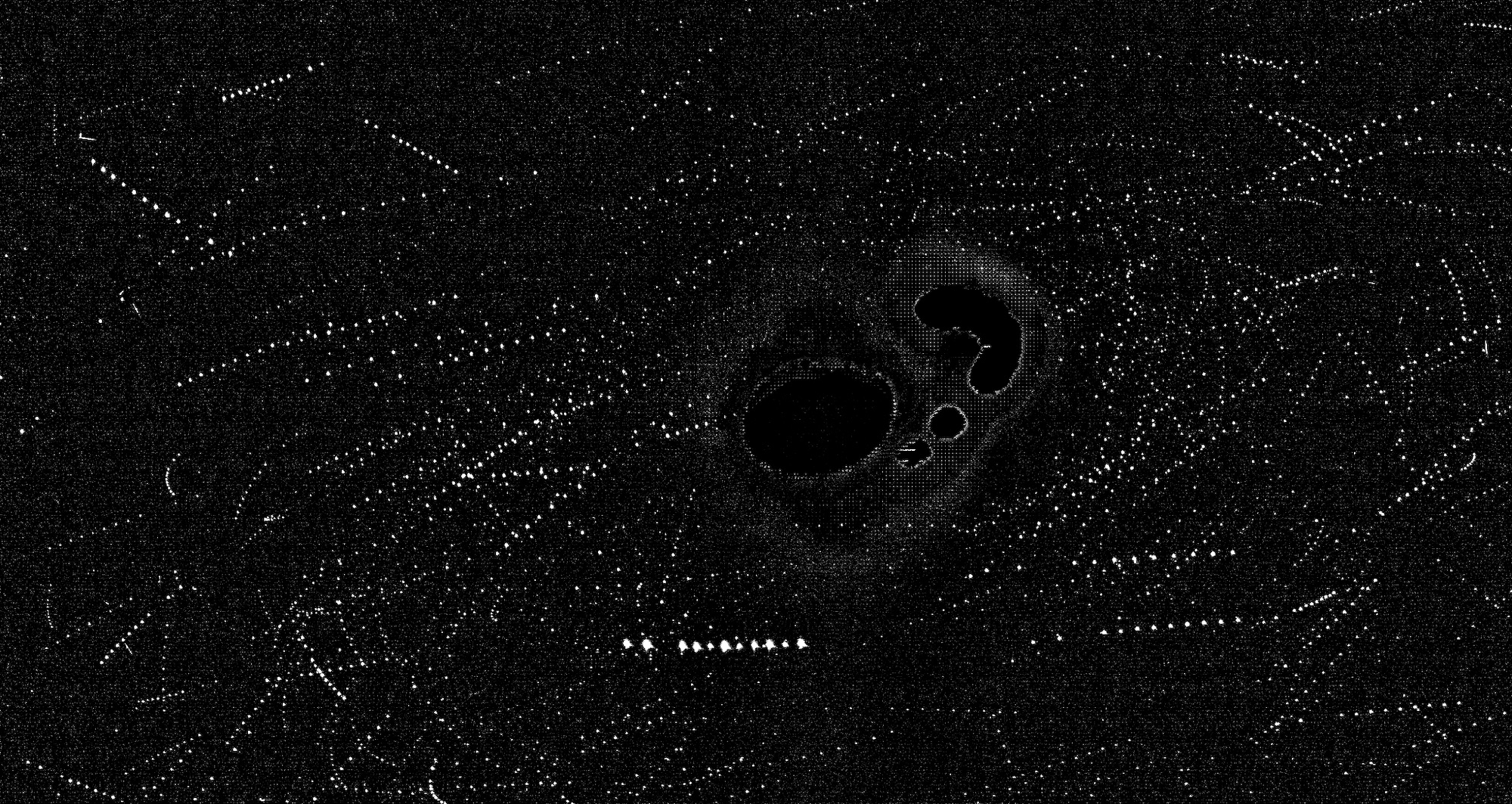
In its initial reconnaissance this month, Hera spotted hundreds of boulders surrounding the double asteroid. This was not entirely unexpected. A picture taken by the Hubble Space Telescope shortly after DART’s impact showed a cloud of material streaming behind Didymos and Dimorphos, but scientists were astonished by the extent of the debris swarm in Hera’s first images.
“As we approached Didymos and Dimorphos, we quickly realized the asteroids were not alone,” said Naomi Murdoch, planetary scientist at the Institut Supérieur de l’Aéronautique et de l’Espace in Toulouse, France. “In fact, they had a lot of company.”
An image released by ESA on Wednesday combines 11 long exposure frames from Hera’s hyperspectral camera. Image processors on the ground digitally removed the relatively bright Didymos and Dimorphos to reveal a panoply of dimmer streaks and dots, each of which is a rock fragment ranging in size from a football to a washing machine, Murdoch said.
“Hera came to visit two asteroids, and we found hundreds of companions,” Murdoch said.
One obvious explanation for the boulders is they were thrown off Dimorphos when DART slammed into it. But scientists cautioned they need more information before they can say that with surety. Hera is the first space mission to undertake a sustained study of an asteroid with its own moon. The debris around the two asteroids might be relics from the creation of Dimorphos some time in the ancient past.
“Hera will allow us to study that in more detail,” Murdoch said. “We really need to know more about these boulders and characterize them to understand if they’re linked to DART, if they’re linked to another process, and what the consequences might be for other asteroid systems in the Solar System.”
The boulder field will create challenges for navigating around the asteroids. The boulders are an added risk for the two small CubeSats Hera is supposed to deploy in January.
“We saw a couple of images that didn’t reassure me,” said Margherita Cardi, project manager for the Milani CubeSat. “There is a mix of excitement and panic.”
Claudia Balossi, spacecraft systems engineer for Hera’s other CubeSat, named Juventas, said her mission’s planned trajectory would take it right through the boulders as it moves within a couple of miles of the asteroids, then finally toward a landing attempt on Dimorphos, where it will measure the miniature world’s tenuous gravity field.
“We are right in the middle of it,” Balossi said. “The smallest ones are probably just as big as we are and the biggest ones are very big. In the worst case, a boulder will land on us. We will activate our gravimeter right away [if that happens],” Balossi joked.
The good news is the asteroids’ gravity is so weak that Hera, Milani, Juventas, and the hazards around them all move at snail-like speeds. Hera’s current trajectory takes it around the asteroids at a relative velocity of just a quarter-mile per hour, or about 12 centimeters per second. At that speed, there’s no danger of a sudden catastrophic hypervelocity collision between the spacecraft and the boulders lurking nearby.
Scientists have seen this at an asteroid before. NASA’s OSIRIS-REx spacecraft kicked up an estimated six tons of rock and dust when it gently moved in to collect a sample from an asteroid named Bennu in 2020. Low gravity and weak surface cohesion are a recipe for outsized effects.
“These types of bodies, because of their low gravity, have a very counterintuitive behavior,” Michel said. “Each time we interact with them, whether to take a sample or to make an impact, the response of the surface was not the one we predicted, simply because our intuition relies on what we experience every day on Earth. Even if the rules of physics are the same in the Universe, they express very differently depending on local attraction.”