In the aftermath of the 2011 earthquake that triggered a devastating 40-metre tsunami along Japan’s Pacific coast, taxi drivers in the Iwate port town of Kamaishi started reporting strange happenings.
Several drivers described picking up passengers who vanished during their journeys. The taxi community began to refer to them as “ghost fares”. The phenomenon soon attracted attention of news outlets, and even academics. Now these ghost fares are the subject of an equally strange film called Ghost Town, directed by British documentary maker Katherine Round.
The wall of water precipitated by the 9.0 magnitude earthquake on March 11 meant that casualties were almost entirely from coastal areas, mainly Fukushima, Miyagi and Iwate. Almost 20,000 people were killed and another 2,500 were reported missing.
I first came across these stories of ghost fares while working on my PhD, which focused on cultural engagement with dying and death. In a 2014 article Richard Lloyd Parry, the Tokyo-based Asia editor of The Times, wrote:
A cab driver in the city of Sendai picked up a sad-faced man who asked to be taken to an address that no longer existed. Halfway through the journey, he looked into his mirror to see that the rear seat was empty. He drove on anyway, stopped in front of the levelled foundations of a destroyed house, and politely opened the door to allow the invisible passenger out at his former home.
An in-between space
Round came across the phenomenon following a devastating loss of her own. Known for her deeply humane documentaries that follow the lives of ordinary people, she flew to Japan, where she rigged the cabs of four Kaimishi taxi drivers with cameras, and invited local residents to take a ride. Round describes her film as “an enquiry into memory, myth, life and death”.
The film follows four drivers – Konno, Iwasaki, Goto and Koike – mostly at night, as they weave their way through the streets “picking up occasional passengers and conversing with a visitor to the town about their lives”.
Rather than a documentary with an obvious narrative arc, Ghost Town is, as the director describes, a film that explores “a liminal space between documentary and dream”.

Audiences feel as if they, like the passengers of the taxis, are between one place and another, witnessing what passes by. With large stretches of silence and frequent changes of location between taxis, the audience is taken on a journey over the course of one night, moving ghost-like between different spaces and places and overhearing a range of conversations.
Journalist and filmmaker Shiori Ito – whose Black Box Diaries unleashed Japan’s Me Too movement – was part of the team, working with the people of Kamaishi to help create an inclusive process that locals could feel involved in. Once filming was underway, Ito also became a part of the film itself, taking on the role of one of the taxi passengers giving an outsider’s perspective.
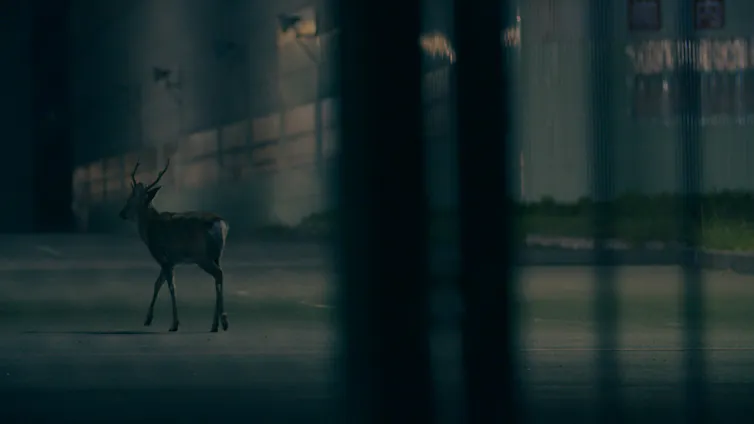
The film has a moving, hypnotic quietness, but it’s never actually quiet. When the driver and passenger aren’t talking, the vehicle itself seems to take over: the hum of its electric engine becomes more pronounced as it glides through deserted streets; the radio seems to get louder; and the repetitive ticking of indicators becomes rhythmic and mesmerising. Outside there is a melancholy stillness to the darkness, punctuated by the pooled light from streetlamps.
For Round, the taxi became a “mobile confession booth”, with drivers and passengers sharing spontaneous stories about their experiences and memories, their lives, fears, hopes and regrets. While we know the drivers are real, we never quite know for sure if the person making the journey is real or an actor. The truth is never explained.
In this way the ambiguity plays on the idea of the ghost fares. These passengers could just as easily be imagined or, in effect, the ghost passengers that Kamaishi taxi drivers maintained they picked up after the tsunami.
Like Iranian director Jafar Panah’s film Taxi Tehran (2015), the technique of using cameras inside a car allows for a unique perspective on a location, seeing it pass by through windows as drivers and passengers look out, ask questions and share thoughts.
In Kamaishi, one driver mentions a “a phone box filled with spirits” trying to get through. It reminded me of another Japanese phenomenon, the “wind phone”: a disconnected phone box that gives the living a place to speak with the dead and express their grief.
In an episode of The Death Studies Podcast disaster recovery expert Lucy Easthope talks about how surprisingly similar disasters are around the world: big, life changing, and traumatic, they offer “brutal teachings”. There is a world before the disaster, and a world after the disaster.
The Kamaishi shown in Ghost Town has been reconstructed with modern buildings and roads, but seems deserted and haunted, its communities broken, interrupted and forever changed by the tsunami.
Regular sirens and preparation drills feature in Round’s film, reminding audiences of the risk natural disasters continue to pose. One particularly striking scene shows a taxi driver enjoying a break with his sudoku, at his favourite spot overlooking the water. Even though it was an enormous column of water barrelling in from the ocean that destroyed these coastal towns, the presence of water in Ghost Town is calming and benign.
Ghost Town functions as a retelling, a document, a memory and a reminder of the many individual lives that are affected by disasters. And of the losses they produce, and the people and legacies they leave behind.