On November 10 2026, PlayStation and Xbox owners across the UK began downloading a 212GB file. Grand Theft Auto VI (GTA VI) would not come out until November 19, but the pre-load alone broke Virgin Media O2’s records for peak traffic and daily data volume.
In December 2023, GTA VI’s first trailer drew more than 93 million views in 24 hours, a YouTube record for a non-music video. In May 2025 the second trailer exceeded 475 million views in a day.
But one of the most telling signs of the game’s cross-cultural reach comes from basketball. On November 18, the eve of GTA VI’s release, the Miami Heat basketball team hosted the Milwaukee Bucks in a regular NBA game the club billed as “A Night in Vice City”.
Vice City is Grand Theft Auto’s fictional version of Miami, and for one night the Heat basketball team existed in that world. The players wore Vice City kit and fans were able to snack at Burger Shot and Cluckin’ Bell, the game’s fictional fast-food chains.
Between 2018 and 2021, the Heat’s “Vice” jerseys paid tribute to the 1980s TV drama Miami Vice. This time around the reference point is a video game. It is clear that video games are no longer simply covered by other culture – they are actively reshaping it.

This article is part of our State of the Arts series. These articles tackle the challenges of the arts and heritage industry – and celebrate the wins, too.
Read more: Quality time and gifting flowers: why we love that GTA became a game about relationships
But it wasn’t always like this. In our forthcoming book, Consuming Video Games, fellow sociologist Tom Brock and I trace how video games began as experiments in military-funded research labs, then moved into bars and arcades alongside jukeboxes and pinball machines.
These were largely the haunts of young men, and jukeboxes and pinball carried an air of youthful rebellion as a form of leisure that felt distinct from adult respectability. Arcade games took that image with them when consoles and home computers brought them into living rooms and bedrooms. Parents, teachers and commentators dismissed them as a frivolous distraction, or simply a passing craze.
My colleagues and I argue that games have been held back by a particular stereotype of young, geeky, possibly toxic masculinity. That stereotype was not without foundation.
For decades, games were marketed mostly at boys and young men. Women who played, made or wrote about games sometimes faced abuse. This was most visible during the 2014 GamerGate campaign that saw an orchestrated barrage of online abuse against women in gaming. But the behaviour of a vocal minority came to stand in for the medium as a whole, and our research with women in the industry and in gaming communities suggests that while there is still work to do, the culture is far broader than the stereotype allows.
Read more: Nearly a third of female gamers feel guilty about their hobby – new study
Yet the old image lingers. One survey from our research suggests people still place video games alongside reality TV, tattoos and shopping malls as having no cultural value at all.
Finding its own path
Shut out of respectable culture, gaming built its own. Players “copied and swapped game tapes, traded tips in playgrounds, and read magazines”, while specialist magazines and TV programmes taught people how to talk about games. Games are now played, but also watched, discussed, performed, collected, mourned and lived.
The scale is no longer in question. More than half of British adults play video games, yet popularity is not the same as respect.
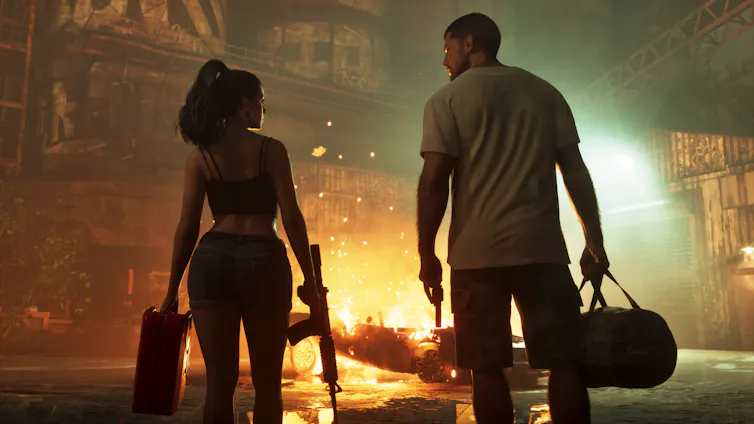
Writing in the Guardian’s gaming culture newsletter, Pushing Buttons, Keith Stuart predicted that coverage of GTA VI would follow “a familiar pattern”, with reviewers admitting they haven’t played a game since Pac-Man, “in a way they never would while discussing any other art form”. Jamie Sefton, managing director of the northern games network Game Republic, said he remains baffled “as to why games are still not covered extensively in mainstream media”.
Much in the same way film came to be taken seriously as art, legitimacy rarely comes from inside a culture. It is granted by outsiders who already hold cultural authority: critics, curators, broadcasters and funders.
Read more: How GTA 6 became a global phenomenon we can’t ignore
Even then, only certain games are seen as having artistic merit, usually smaller independent ones such as Journey (2012) or Disco Elysium (2019). Blockbusters such as Call of Duty (2003) rarely, if ever, are. This splits games into a handful of worthy games and the rest, which does little for the medium as a whole.
GTA VI sits firmly in “the rest”. It is loud, commercial, violent and controversial, the kind of game that cultural gatekeepers have learned to dismiss. But in August 2026, Netflix premiered the GTA VI preview where it recorded 31.1 million views in four days and ranked top of the platform’s English-language film chart. A few months later, an NBA team dipped into the world of Vice City. These are exactly the kind of “outsiders” that can shift how a medium is seen.
Film, television and pop music all made the journey from dismissed to respected, and it is tempting to ask when games will follow. But asking whether games are art is possibly the wrong question. What matters is the place they already hold in people’s lives – and that broadcasters, sports clubs and others outside gaming are starting to take note.
This article features references to books that have been included for editorial reasons, and may contain links to bookshop.org; if you click on one of the links and go on to buy something, The Conversation UK may earn a commission.