Bucking recent trends, fossil fuel emissions look to be down 0.4 percent.
Evaluating the annual global temperatures each year requires context. There is a fair amount of natural variability from one year to the next, so it’s important to focus on the trend over time. Famously, global warming did not end in 1998, as some claimed a couple of decades ago—we just had a run of La-Niña-dominated years after a very strong El Niño.
Annual greenhouse gas emissions are much less variable, having increased fairly steadily, but many complicating factors can still muddy the picture. Sometimes those factors conspire to throw a year off the trend. It looks like 2026 will be one of those years.
A new analysis led by Corinne Le Quéré at the University of East Anglia estimates that fossil fuel emissions have fallen about 0.4 percent from last year. This probably isn’t a peak that symbolizes heartening progress on climate change, though; the researchers think it’s a short-term dip driven by the war in Iran and its effect on oil prices.
Shifting percentages
This team works on the Global Carbon Project, which compiles stats on fossil fuel use and things like deforestation to track carbon emissions globally and by country. In this case, they looked at the stats and tried to pull out key underlying trends that show us what to expect over the next couple of years.
Last year, fossil fuel emissions increased 1.2 percent, a bit above the 2019–2025 average of 0.8 percent per year. This year’s decline featured a 1.9 percent drop in oil emissions, a smaller 0.3 percent drop in emissions from natural gas use, and a 0.6 percent in coal emissions.
Unlike the pandemic-driven drop in 2020, this wasn’t driven by a widespread decrease in energy demand. Demand did increase, but additions of electric vehicles and solar and wind generation covered almost 70 percent of the growth. Electric vehicles can account for only about 20 percent of that consequential decline in oil emissions, meaning the bulk is due to high prices.
One simple way to break down emissions is to connect it to economic output. Given a country’s gross domestic product (GDP), energy use per unit GDP, and carbon emissions per unit energy, you can calculate total carbon emissions. GDP might go up, but if that’s due to less energy-intensive industries or a cleaner energy system, carbon emissions might not rise with it.
Between 2019 and 2025, 59 countries cut their emissions despite economic growth, even as global emissions increased by 0.8 percent per year. The researchers estimated that, had the economic growth not been accompanied by the growth of electric vehicles and solar and wind generation, the increase would have been much higher, at 1.9 percent per year.
Close, but not there yet
Given the International Monetary Fund’s projection for GDP through 2028, the researchers extrapolated these trends forward as well. From that, we would expect global fossil fuel emissions to continue increasing. That includes the present year—without the shock to oil prices, we would be seeing emissions increase in 2026 as well.
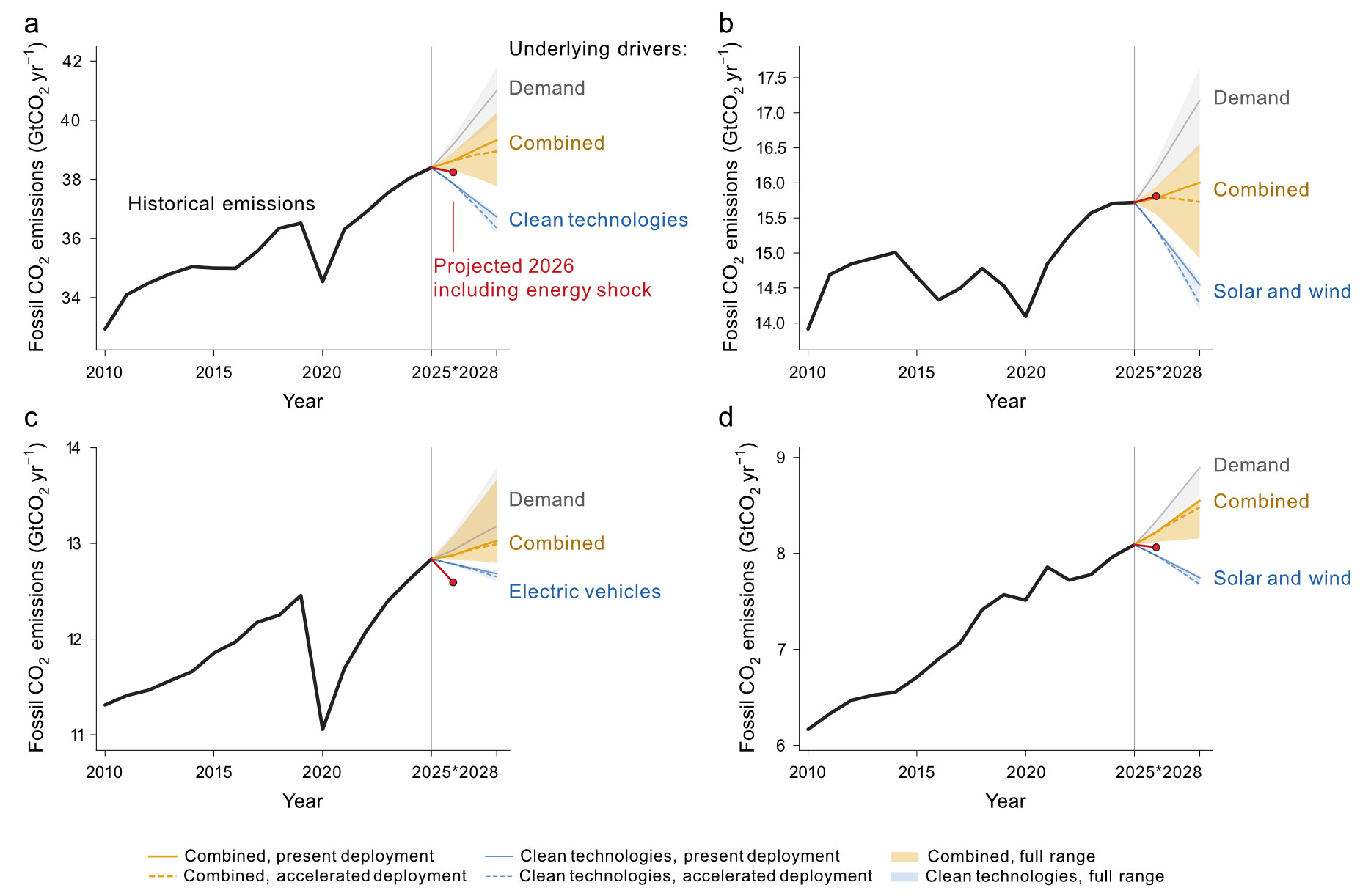
So while we be close to peak emissions, we’re probably not there yet. The growth of electric vehicles and renewable energy is offsetting most of the growth of emissions, but not all of it. That would take just a bit more juice.
The researchers write, “If further acceleration of clean technology deployment can be supported through time, a sustained peak and decline in global CO2 emissions could be a few years away.”
Nature Climate Change, 2026. DOI: 10.1038/s41558-026-02821-8 (About DOIs).