The cost of components makes this a tougher decision than ever.

We may receive a commission on purchases made from links.
For the longest time, it was more affordable to build a PC that could outshine consoles than buy a pre-built rig (with the massive proviso that you knew what you were doing). Unfortunately, we currently exist in a world where mega corporations trying to chase the bucks in courting AI have made graphics cards, memory and storage ultra expensive. There's arguably rarely been a time when it's financially smarter to buy a PC than build one, but things may be changing. Keep reading to find out whether building a gaming PC is wise (and affordable) compared to ordering a pre-baked rig without the hassle of sourcing individual components.
Is it better to buy or build a gaming PC?

In years gone by, this would be a slam-dunk easy answer. Sadly, "years gone by" isn't the world we currently live in. Historically, building a PC yourself has been cheaper (while also giving you more control) than buying a pre-assembled rig with similar specs. Though constructing your own PC might feel like a Herculean task at first, once you school yourself and watch a few YouTube tutorials, it's akin to assembling techy Lego blocks. No matter your enthusiasm for PC building, though, RAMageddon has changed the game.
The global memory and storage crisis, which has sent the price of RAM and SSDs through the roof due to the demands of AI data centers, has significantly impacted PC gamers. It's no wonder a lot of you panic-bought PCs to avoid RAMageddon. Jump over to Amazon right now, and you'll be hard-pressed to find 16GB of DDR5 RAM for much less than $250. A couple of years ago, those prices would have seemed unhinged, but here we are.
The current reality of the pros and cons of buying vs. building a PC is on a knife-edge. If you've been building your own rigs for years, you're going to keep charting that course, mainly because you want total control over the components in your PC. But for those who don't have any experience assembling a gaming rig, buying a pre-built PC has rarely been of better value than it is today.
Is $1,000 enough to build a PC?

At the time of this writing, building a $1,000 rig that will do justice to modern triple-A titles is going to be tricky with those aforementioned sky-high RAM and SSD prices. If your heart is set on 4K/60 FPS gaming, you're better off going for either a PS5 or an Xbox Series X (even if the use of upscalers means true 4K is still pretty rare on consoles). Assembling a $1,000 gaming rig that can handle the likes of in Ultra HD at buttery frame rates just isn't in the tea leaves.
If you're happy to game at 1440p and can stretch your budget to around $1,200, that's a less daunting task. Should you be set on building a decent gaming PC for $1,200 and not a penny more, you need to be savvy about the components you buy. So let's get into how you can put together a respectable rig at that price point. Alternatively, you could forgo the hassle and splurge on an MSI Codex Z2 RTX 5060Ti Gaming PC for $1,300 and rest easy knowing every potential Blue Screen of Death will be protected under warranty.
How to build a good gaming PC for $1,200

Before we break down your potential next rig, know that the prices we're about to discuss will hopefully drop in the future. When it comes to PC gaming, the GPU is obviously king. For 1440p/60 FPS results in modern titles, aim for a card with at least 8GB of VRAM, like the NVIDIA GeForce RTX 3070. Thanks to its 46 dedicated RT cores, the 3070 can handle ray tracing without completely tanking frame rates (as long as you use DLSS). If you're lucky, you can sometimes find it on sale for less than $400.
Providing you can grab that GPU at a discounted price, we've still got plenty of money to play with. Your next port of call should be to pick up a decent gaming CPU. For solid 1440p gameplay, go for a six-core/12-thread processor (something like the AMD Ryzen 5 7600X, which often goes on sale for around $160).
Assuming you can bag those deals, try to grab 16GB of DDR5 RAM for around $250. As for those remaining funds, if you're going with the CPU we've suggested, you'll want a motherboard with an AM5 socket. Go for a board from a reliable manufacturer like ASUS or ASRock, which you should be able to acquire for around $150.
With your remaining budget, look for a decent 650W PSU, which you should be able to source for roughly $55. Regarding efficiency ratings, aim for a platinum- or gold-rated power supply. What remains of your cash should then go to a reliable 512GB SSD and a mid-tower PC case, which should be obtainable for less than $200. Presto! You've just assembled a very capable gaming PC for under $1,200... providing RAMageddon doesn't get worse.
Is it still worth building your own PC in 2026?
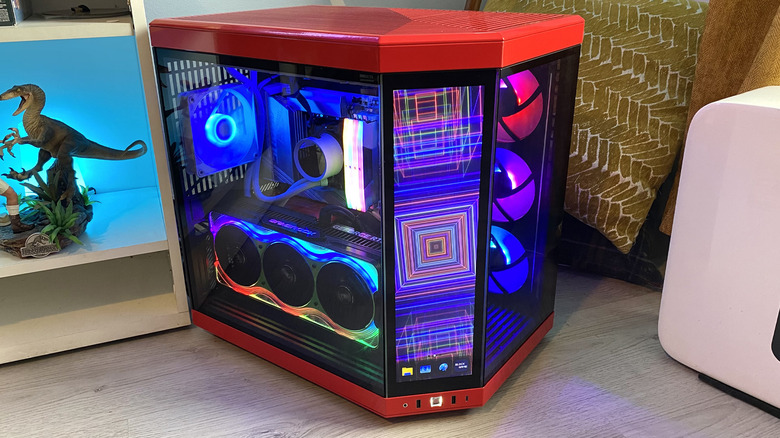
In an era where the entry-level Steam Machine would have been perfect five years ago yet somehow costs $1,049 and broadly can't match the performance of the $899 PS5 Pro, putting together a rig that can match the performance of current consoles clearly isn't easy. That's not to say building a top-notch gaming PC isn't still worth it. If you're lucky enough that money is no object, assembling a rig like the one pictured above, which can deliver 4K/120 FPS gameplay thanks to an RTX 5090 GPU and an AMD Ryzen 7 9800X3D CPU, is incredibly satisfying and beats the brakes off the best technical experiences even the PS5 Pro can provide.
For the vast majority of PC gamers, such a setup is obviously overkill. Though building a PC that can match Sony's supercharged console for roughly $800 is basically out of the cards, those who aren't obsessed with 4K gaming would be well advised to construct a 1440p-focused gaming PC that will look great on a 27-inch monitor. Building a PC in current times is definitely worth it if you're a hardcore enthusiast. Yet for those who are willing to eat elevated hardware costs for the long-term benefit of picking up the PC games at massively reduced costs during regular Steam sales without needing to put the PC together yourself, a $1,500 pre-built rig is an attractive alternative.