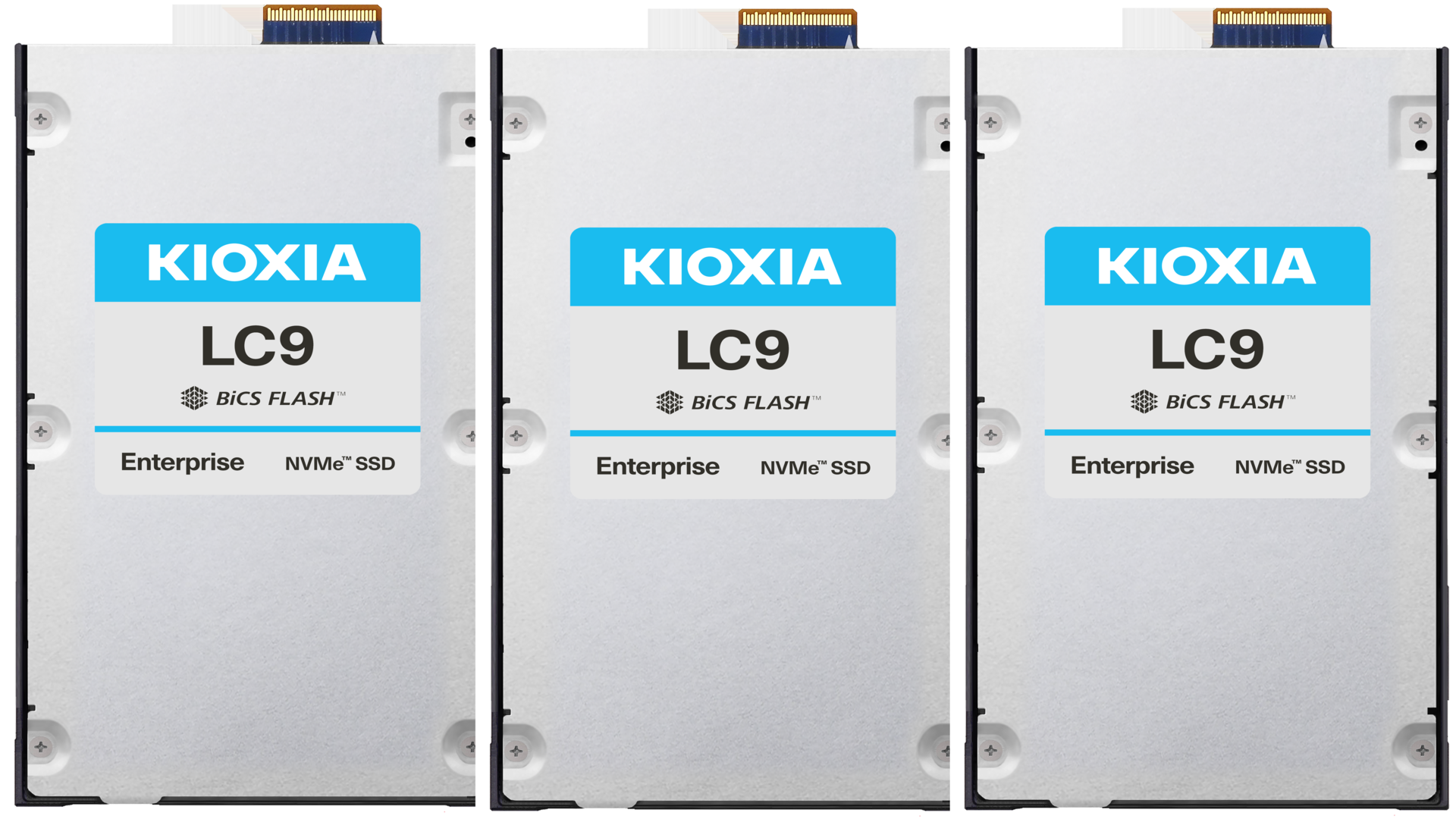
- Dell fits 640 high-capacity SSDs into a standard 42U server rack
- Kioxia's latest configuration delivers 157 PB across just 16 servers
- The Dell installation occupies 32U, leaving 10U available for equipment
Kioxia and Dell Technologies have combined 640 high-capacity solid-state drives to achieve 157 PB of raw flash storage within one server rack.
The configuration uses 16 Dell PowerEdge R7725xd servers, each equipped with 40 Kioxia LC9 Series SSDs rated at 245.76 TB.
The companies describe the installation as an industry-first achievement, although competing storage developers have reported configurations with even greater rack capacities.
640 SSDs deliver 157 PB of storage capacity
The installation runs Dell's ObjectScale software, an object-storage platform designed to manage enormous collections of unstructured information.
Its intended applications include artificial intelligence training, large-scale data analysis, and cloud services requiring substantial storage capacity.
Each PowerEdge server occupies 2U of rack space and accommodates 40 E3.L SSDs - and with 16 servers installed, the configuration consumes 32U of the standard 42U enclosure, leaving another 10U available for additional equipment.
The arrangement follows an earlier collaboration between the companies, which produced a configuration offering 9.8 PB of flash storage per server.
Multiplying that capacity across 16 machines produces approximately 157 PB, explaining how the latest installation reaches its advertised figure.
Kioxia's LC9 drives use eighth-generation BiCS FLASH technology, incorporating quad-level cell architecture and a 32-die stacking arrangement.
The drives also support PCIe 5.0 and NVMe 2.0, while their advertised mean time to failure reaches 2.5 million hours.
However, the maximum 245.76 TB capacity applies specifically to the E3.L version. The alternative 2.5-inch and E3.S models offer capacities reaching 122.88 TB, substantially reducing the available storage within an equivalent configuration.
The companies argue that concentrating more information into fewer servers can reduce cabling requirements, electricity consumption and cooling demands.
Dell also believes the arrangement could help organizations accommodate expanding AI datasets without continually increasing their physical storage infrastructure.
“AI is driving unprecedented growth in unstructured data, and customers need to scale capacity without scaling their data center footprint and power consumption,” said George Papadopoulos, SVP, Product & Engineering, Dell Technologies.
“With Dell ObjectScale and KIOXIA’s 245.76 TB SSDs, customers can consolidate more data into fewer systems and racks while reducing cabling, power and cooling requirements. This collaboration helps deliver a more efficient, scalable foundation for AI and data-intensive workloads.”
Nevertheless, the announcement provides no measured electricity consumption, cooling figures or comparative performance results establishing the actual savings.
Competition is another consideration, particularly because Micron has introduced its own 245 TB 6600 ION SSD.
The company advertises configurations reaching 176.9 PB within a rack using the E3.L form factor, exceeding Kioxia's stated capacity.
Novodisq has also reported an even higher capacity, claiming that its proprietary 144 TB SSDs can deliver 230 PB within a standard 42U rack.
Its Novoblade architecture uses modular storage blades containing multiple drives, allowing the company to achieve approximately 46% more raw capacity than the Kioxia and Dell installation.
However, independently verified performance, power consumption and cooling measurements would help establish whether its architecture delivers comparable operational advantages.