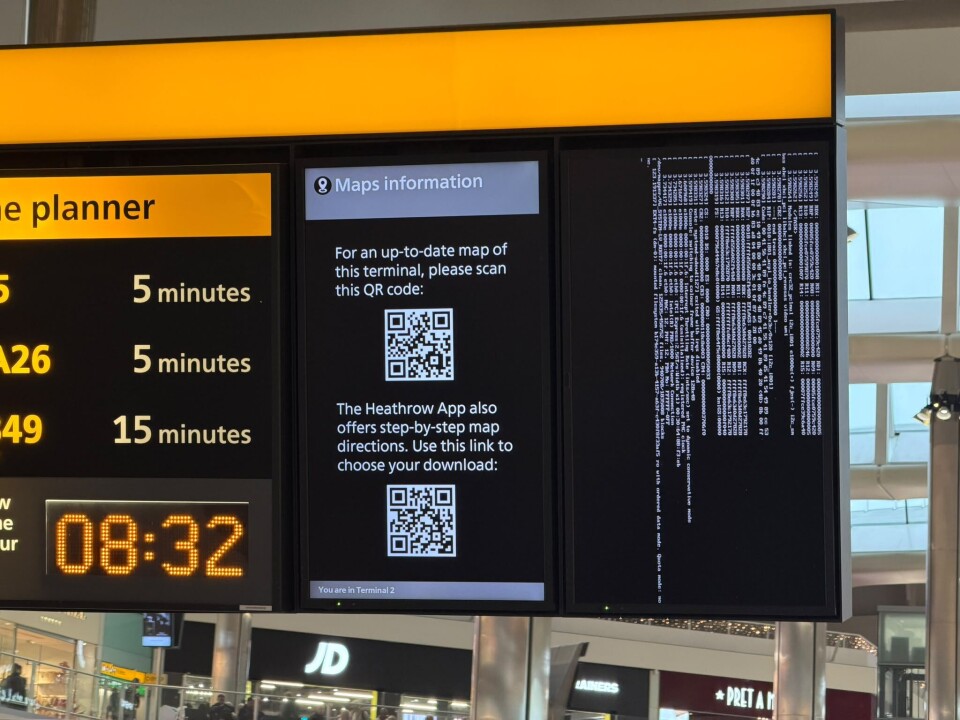
UK travelers had more than fog to contend with this week, as Linux proved that if Windows could bork anything, it could bork it better.
Spotted by Andy Hinks at Heathrow Airport's Terminal 2, this information display has seen better days. While its neighbors offer walking times and terminal maps, it presents a sideways Linux boot log – useful only if your next connection involves mounting a filesystem.
There aren't many clues to what has befallen the machine behind the screen. The boot messages mention , an Intel PRO/1000 network adapter, and an EXT4 filesystem on what appears to be a logical volume named . Whether mounting that filesystem is the problem, or simply the last thing displayed before something else went wrong, isn't clear.
Heathrow's information displays clearly accommodate a mixture of technologies. Recent examples ran Microsoft Windows, which had - naturally - suffered a moment of its own. Linux can evidently be just as unreliable in the right hands.
The question is which Linux distribution is having its moment in the sun. Heathrow has been rolling out Raspberry Pi-based signage, although the Intel PRO/1000 adapter leaves the hardware behind this particular display something of a mystery.
Pi hardware makes sense for signage: it's relatively cheap – at least until AI ate all the RAM – and low-powered compared with a full-fat Windows PC. Heathrow's senior product owner for displays described the approach as a "reliable, secure solution that has a significantly lower hardware cost and are 30-40% more energy efficient than our previous hardware."
Readers might be interested to know that Heathrow has spent years working on its new screens. The product owner again: "We've completely re-engineered our content distribution system to be flexible and device-agnostic."
So Windows in one place, and Linux somewhere else. All rubbing along famously. Assuming, of course, the displays can show more than a virtual cough and splutter during boot. ®