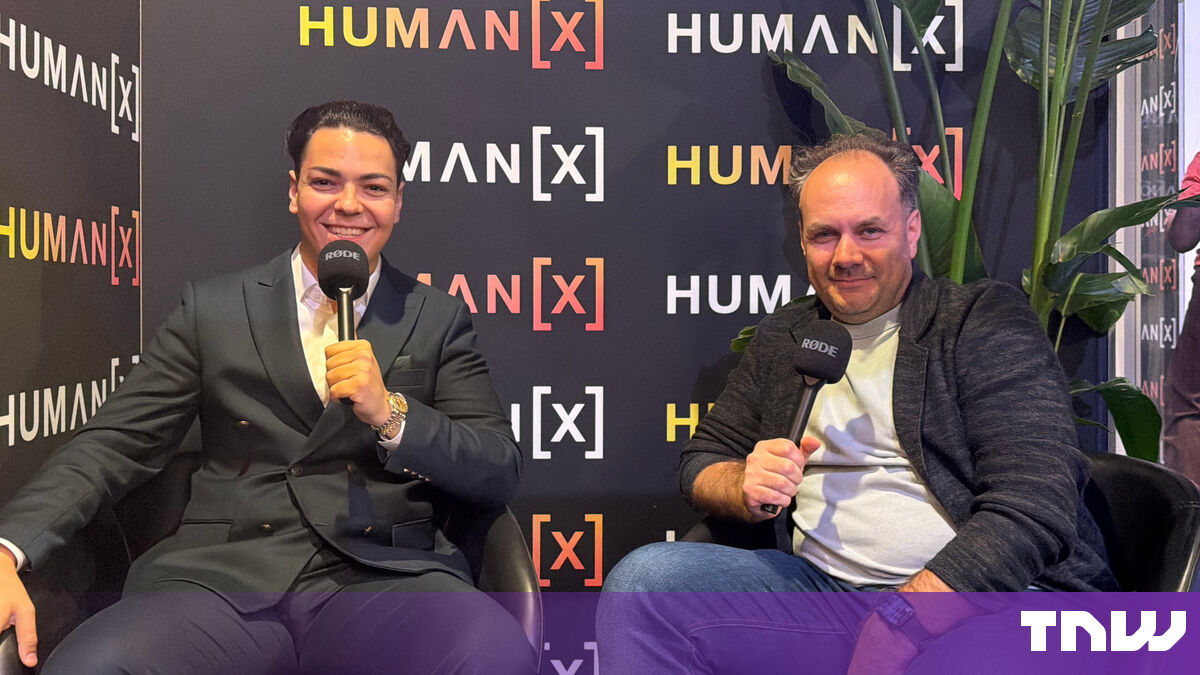
Asked what breaks first when a company grows as fast as Nebius, Danila Shtan gave a one-word answer: everything. The scale and the pace of growth test everything his team builds, all the time, the Nebius CTO told TNW.
“You start building, you have some expectations about the growth or the client’s needs or the performance they need, and they come to surprise you every day.” Danila Shtan, CTO of Nebius
Shtan described Nebius as a Dutch company and one of the largest AI clouds in the world. He spoke to Cristian Dina for the TNW Podcast at HumanX in Amsterdam on 24 September. That day he also joined a fireside chat on the main stage about making AI agents work at scale.
Earlier episodes featured Alexander Rinke of Celonis, Kristin Fracchia of Gamma, and Daniel Dines of UiPath. The full conversation is in the video below.
Nebius provides the infrastructure for training and running AI models and for building applications on them, Shtan said. He leads software development, so his team builds the software that runs on the servers.
“They need access to high performance computing, which is essentially the heart and the blood and everything of the current AI revolution, hype, whatever you call it.” Danila Shtan, Nebius
Some customers spend hundreds of millions on the platform, he said. Others spend $50 to run a small slice of compute for half an hour of internal experiments.
Talking to people, and coding again
Shtan’s team is about 500 to 550 people. His day is mostly talking to them, he said. He checks on projects and gives feedback when something goes very wrong. Nebius builds a platform, but it also builds data centres, which he called a parallel organisation.
AI coding agents have him building again. He can test an idea in hours or days and show the team a rough prototype instead of talking them through it. His thought process was always faster than his implementation skills, he said, and agents now take on that part.
Sovereignty has many angles
A significant portion of Nebius’s customers are American companies, Shtan said. American customers use European capacity, and European customers use American capacity.
European governments talk about sovereignty as infrastructure, he said. The US government talks about models and capabilities. Large companies talk about not depending on a single model vendor. He called all of these angles correct.
“I feel like sometimes they’re over-hyped, and this is not good for anyone. It’s not good for business.” Danila Shtan, Nebius
An independent player
Nebius wants to be one of the most important independent AI cloud companies in the world, Shtan said. Much of today’s AI capacity sits with vertical players that own the chips, the data centres, the models and the apps. He wants alternatives at every layer, including model vendors and consumer apps.
“So we are all for diversity, and we are all for, like, building this independent layer of AI because too much power in one company’s hands, even if it’s a good company is never a good idea.” Danila Shtan, Nebius
Its biggest challenge is growth, he said. Demand keeps rising for large, small and specialised models, and the bottleneck is no longer only GPUs. It is also memory, disks, servers, electricity, land and high-voltage equipment.
Ideas matter again
Shtan has been an engineering manager for about 25 years. He started as a software developer and moved quickly into managing people. He has worked in warehouse automation, retail, fintech, biotech, a news outlet and a classifieds website. Later he moved into developer tooling, clouds and Nebius.
For young builders, he said, this is a great time, because a large team is no longer needed to ship a successful product. Taste in product and the ability to sell it now matter more. Five years ago, he said, the maxim was that ideas don’t matter and execution does.
“Now, execution is quite cheap, so ideas matter again.” Danila Shtan, Nebius
Companies fail at AI when they treat it as magic, he said. His advice is to learn its limits, experiment, fail and try again.
“AI is not a magical thing. It’s a tool.” Danila Shtan, Nebius