When Archive of Our Own , the world’s largest fanfiction archive, announced that it could be unavailable for weeks following a “security incident”, many readers reacted with some distress. Across social media, fans half-jokingly talked about experiencing withdrawal symptoms and mourned interrupted reading schedules.
The reaction may seem uniquely digital. Yet, readers waiting for the return of Archive of Our Own have more in common with 18th- and 19th-century readers than they might realise.
Many fanfiction writers publish stories chapter by chapter, often releasing updates according to a regular schedule over weeks, months, or even years. This allows readers to follow narratives in real time. The result is a shared experience of suspense, discussion and speculation.
Long before online archives existed, popular fiction was also often consumed in instalments.
Improvements in printing technology, together with rising literacy rates and expanding commercial networks, enabled books, periodicals and newspapers to reach larger audiences than ever before. Books nevertheless remained relatively expensive commodities because of the costs associated with paper, printing and binding. One early solution was to issue works in instalments, or fascicles, which were separately published instalments of a book or other printed works. This approach allowed publishers to spread production costs, and the related financial risk, over time, reducing the upfront cost for readers. Whether by design or accident, serialisation also served to create a culture of anticipation as audiences waited for the next part of a story.
A shared activity
Serial publication is only part of the story. Some modern fanfiction communities are characterised by a high degree of interaction between writers and readers. Readers comment on chapters, speculate about future developments, offer feedback, and sometimes even influence the direction of a work as it is being written.
While the technologies are different, this kind of participatory reading culture would have been familiar to 18th- and 19th-century authors. Samuel Richardson, for example, encouraged and embraced interactions with readers, and was notoriously attentive to their reactions. Discussions with friends, admirers, and critics shaped his thinking about Pamela (1740); while reader response influenced the development of its sequel, Pamela in Her Exalted Condition (1741). Although increasingly dismissive of reader feedback as his career progressed, Richardson also revised later editions of Clarissa (1747 to 1748), altering aspects of the text in response to feedback from his readership.
Reading in the 18th century was also rarely a solitary activity. Books circulated through friendship networks, generated extension discussion among readers, and even performed texts aloud.
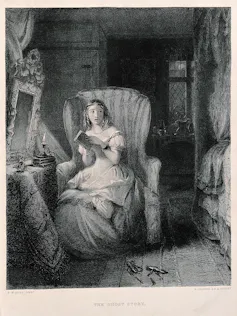
As an avid reader and frequent correspondent, many of Jane Austen’s surviving letters reveal the innate sociability of 18th-century literary culture. On February 9 1807, for example, she tells her sister Cassandra that “We are reading Clarentine, and are surprised to find how foolish it is. I remember liking it much less on a second reading than at the first and it does not bear a third at all.”
Her novel Northanger Abbey (published posthumously in 1817 but written earlier) offers a vivid depiction of this culture. The friendship between protagonist Catherine Morland and Isabella Thorpe is cemented through their shared enthusiasm for gothic novels, particularly the works of Ann Radcliffe. Chapter six sees the two girls avidly discussing Radcliffe’s 1794 novel The Mysteries of Udolpho, with Catherine declaring: “I am delighted with the book! I should like to spend my whole life in reading it.”
Readers having their say
When Arthur Conan Doyle killed off his famous detective in 1893, more than 20,000 readers of the Strand magazine, which published the stories, cancelled their subscriptions and others wrote letters urging the author to reverse his decision. Long before readers could leave comments on fanfiction chapters or express their dissatisfaction with a book’s conclusion at an author signing, literary audiences were already seeking to shape the futures of the fictional worlds they loved.

Holmes’s eventual resurrection has become one of literature’s most famous examples of readers refusing to accept an author’s final word.
Richardson also dealt with his fair share of this. Lady Bradsheigh and Lady Echlin were two readers who were so deeply invested in the fate of Clarissa’s heroine that they suggested revisions and alternative endings to Richardson that would have changed her tragic fate. Although Richardson ultimately resisted such changes.
One of the most well known tenets of fanfiction is its revisitation, revision and expansion of existing fictional worlds. Fans write alternative endings, explore paths not taken by the original author, and create sequels, prequels and parallel narratives that expand fictional worlds beyond their canonical boundaries.
Take Ali Hazelwood’s 2021 romance novel The Love Hypothesis, which was adapted from her 2018 Star Wars fanfic Head Over Feet. Originally published on Archive of Our Own under the pen name Ever-so-reylo, the story imagined an alternate universe to the Star Wars sequel trilogy (Star Wars: The Force Awakens,2015; Star Wars: The Last Jedi, 2017 and Star Wars: The Rise of Skywalker, 2019) in which enemies Rey and Kylo Ren (Ben Solo) become unlikely lovers.
We can see similar engagement with existing worlds in 18th-century works too. For instance, Poems Occasion’d by Reading the Travels of Captain Lemuel Gulliver (1727) was a response to Jonathan Swift’s Gulliver’s Travels (1726) most commonly attributed to Alexander Pope. There was also John Kelly’s continuation of Pamela, Pamela’s Conduct in High Life (1741) and Henry Fielding’s satiric parody Shamela (1741).
So the desire to continue stories, debate characters, recommend favourite texts, or imagine alternative endings endures. What has changed is the speed with which these responses can be shared, the size of the communities that can form around them, and the number of people able to participate. Modern fanfiction is not a break with literary culture so much as the latest manifestation of some of reading culture’s oldest habits.
This article features references to books that have been included for editorial reasons, and may contain links to bookshop.org. If you click on one of the links and go on to buy something, The Conversation UK may earn a commission.