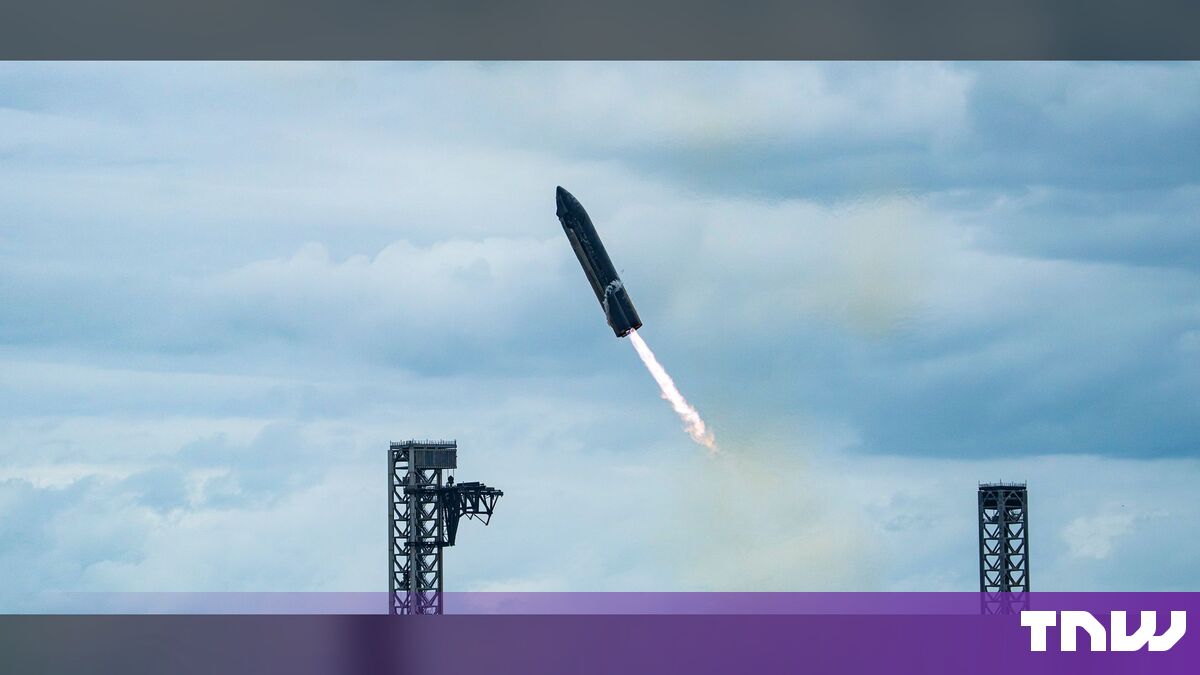
SpaceX caught the upper stage of its Starship rocket with the arms of its launch tower on Saturday. No Starship had ever come back from orbit and been caught before. The ship returned to Starbase, Texas, about 22 and a half hours after lift-off. It slid between the tower’s mechanical arms, nicknamed “chopsticks”.
It was SpaceX’s 15th full-scale Starship test flight and only its second trip to orbit. Marcia Dunn reported the details for the Associated Press. SpaceX had caught the Super Heavy booster on three earlier flights, but never the ship itself. The double catch it wanted, of both stages on one flight, did not happen.
“Can you believe it? Look at her! Baby, she’s back!” SpaceX commentator Dan Huot said on the company’s broadcast.
The booster missed its catch on Friday
The flight began on Friday at 4:47pm local time, when the 124-metre rocket lifted off from Starbase. The plan was for the tower to catch the Super Heavy booster minutes later. SpaceX instead aborted the booster catch.
The booster’s burn to fly back towards the tower “ended early due to low fuel mass”, SpaceX said, according to The Register. Its guidance system sensed it was out of position and sent it offshore. It hovered over the Gulf of Mexico and then exploded. Elon Musk wrote on X that the booster had been “slightly low on fuel”. SpaceX is still investigating the cause.
A day in orbit, then the catch
The ship carried on into orbit and released 26 of SpaceX’s Starlink V3 internet satellites. It circled the Earth 14 times at an altitude of about 265km, according to the AP. On the previous flight, in September, it first reached orbit and managed one to two laps.
SpaceX said everything on the ship, including its heat shield, appeared to work well. On Saturday it fired an engine to leave orbit, fell back through the atmosphere and steered with its flaps. Over Starbase it swung upright, hovered and slid into the arms, Kenneth Chang reported for The New York Times. The ship was No. 42 off the production line and had “DON’T PANIC” printed on its side.
“It was almost magic,” NASA administrator Jared Isaacman wrote on X.
Musk called it an “epic day” and later climbed the tower to film the ship.
“Many small fixes are needed to achieve immediate reusability (like an airplane),” Musk wrote on X.
What is still missing
Even after the first Starship catch, SpaceX has not recovered both stages of one rocket. Malcolm Macdonald, president of the Royal Aeronautical Society, called the lost booster a setback. The ship’s return was a big step forward, he told the BBC.
“They have demonstrated the two halves of the recovery challenge, just not yet on the same flight,” Macdonald told the BBC.
NASA is paying SpaceX to turn Starship into a lander for its Artemis astronauts. A Moon mission needs one Starship to refuel another in orbit, and SpaceX has not yet shown it can do that. Starship’s progress has been far slower than SpaceX intended, the BBC reported, and it bears on NASA’s moon timeline.
Next year’s Artemis III mission will stay in low Earth orbit, where Starship will practise docking with NASA’s Orion capsule. NASA is targeting 2028 at the earliest for Artemis IV, the first crewed Moon landing since Apollo, the AP reported.
Flight 16 could be the first Starship launch from SpaceX’s rebuilt pad at NASA’s Kennedy Space Center in Florida, The New York Times reported. SpaceX can now build a Starship upper stage every three weeks, Eric Berger reported for Ars Technica. Five Starships are in an advanced state of development at Starbase, he wrote.