I’m really enjoying the fact that most people I know who watch Rivals have dropped the “just my guilty pleasure” shtick and now simply confess to full-on loving it.
My own residual guilt stems from the fact that when I was a teenager, my mother, who grew up reading Austen, Dickens and the Brontës, was profoundly disappointed and filled with sorrow to catch me with well-thumbed copies of Jilly Cooper’s Rutshire nonsense. But they were so funny and rude, and also I was horse-mad and a member of the local pony club, so it all just seemed such a good fit. I even went to a fancy ball once in a glittery sequinned boob-tube and thought I was the height of sophistication. Well, it was the 1980s.
Part two of season two picks up after a particularly dramatic part one cliffhanger. Spoiler alert! After discovering the latest affair of her husband Tony (a gloriously nasty David Tennant), long-suffering wife and all-round good egg Monica (Claire Rushbrook) sweeps out of the house in a storm, buckled with grief and humiliation. She somehow finds her windblown way to the house of Lizzie (Katherine Parkinson), also wife to a faithless husband, James (the marvellous Oliver Chris giving hilarious half-Partridge-half-Madeley vibes). The two sit down for a comforting cup of tea, and quickly graduate to the brandy bottle.
But then something extraordinary happens. After her King Lear moment in the storm, Monica is spent and becalmed, and the two women begin to examine the symmetry of their lives with ghastly men who take them for granted. In this scene, says our reviewer Claudine van Hensbergen, the “two frumpiest and most downtrodden women in Jilly Cooper’s Rutshire become the beating heart of the episode – perhaps the whole series”.
It’s Rivals as domestic tragedy, a moment of liberation for two women who realise they would not wish their lives for their own daughters. This poignant scene is the catalyst for change as two worn-down housewives become heroines.
Read more: Rivals season two: why a shocking death in episode six changes everything for the women of Rutshire
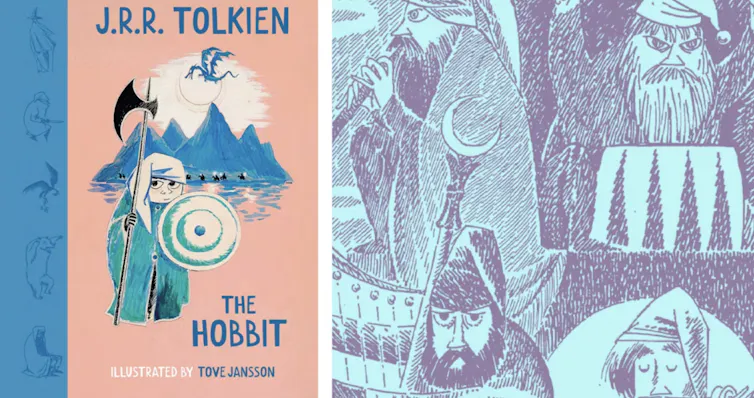
The recent release of The Hobbit illustrated by Tove Jansson marks the first time a full edition of the Finn’s Tolkien illustrations has appeared in English. Of course Jansson is best known for the Moomin tales which she both wrote and illustrated.
But anyone familiar with her early illustrations will understand how perfectly her style lent itself to Tolkien’s elvish epic. The imaginations of both Tolkien and Jansson were fundamentally shaped by Finnish myth and folklore, and there are many similarities between the rendering of her own Moomins and Tolkien’s Hobbit characters.
Read more: Tove Jansson’s illustrations for The Hobbit capture the ‘ecstatic truth’ of childhood
The originality of painters Vanessa Bell and Duncan Grant – central figures of the Bloomsbury set – is often sensationalised, with most focus directed on their unconventional sex lives as much as their modernist art. Now a new show at London’s Tate, Vanessa Bell and Duncan Grant: Inside Bloomsbury attempts to redress the balance and turn that focus back on the art of this fascinating couple.
On show are more than 300 works that trace the couple’s 50-year creative partnership and visitors can enjoy a full restaging of their studio from Charleston, their exquisite house in Sussex.
For the love of Lorca
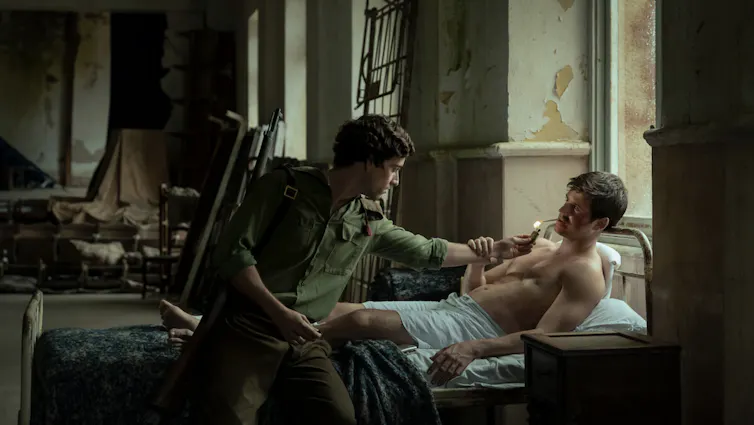
I am so looking forward to watching Spanish film La Bola Negra (The Black Ball). The title comes from the last unfinished play of Federico García Lorca, considered Spain’s most influential 20th-century poet and playwright. This luminous talent was snuffed out when Lorca was executed by firing squad in 1936 at the start of the Spanish civil war, after being imprisoned for his politics and his homosexuality.
Lorca’s unfinished text is a seed that grows and expands into the 21st century, marking three moments in Spain’s history: the second republic in 1932, the civil war in 1937, and contemporary Spain in 2017, taking in three gay stories along the way.
La Bola Negra is in cinemas now.
Read more: La Bola Negra: this deeply moving cinematic homage to Lorca is part of his queer legacy
You Can See Everything is another film I can’t wait to see, which says quite a lot for a three-hour documentary about someone I know very little of. The film has had critics raving as Canadian comedian Nathan Fielder decamps to the house of Elizabeth Holmes, the disgraced founder of medical company Theranos, in her last days of freedom before she is sent to prison.
Holmes was convicted of fraud after it was discovered that the claims of her blood-testing technology were bogus. Fielder gets literally right in the face of the strange, inscrutable Holmes, who claims she can’t really understand where things went wrong.
In this piece, business academics Kate Kenny and Susi Geiger draw our attention to how gendered stereotypes have shaped Holmes’s story and urge us to interrogate the biases we hold about women like her as we watch the documentary.
You Can See Everything is in cinemas now.
Read more: Can you see everything? Nathan Fielder and Elizabeth Holmes face off in You Can See Everything
This article features references to books that have been included for editorial reasons, and may contain links to bookshop.org. If you click on one of the links and go on to buy something, The Conversation UK may earn a commission.