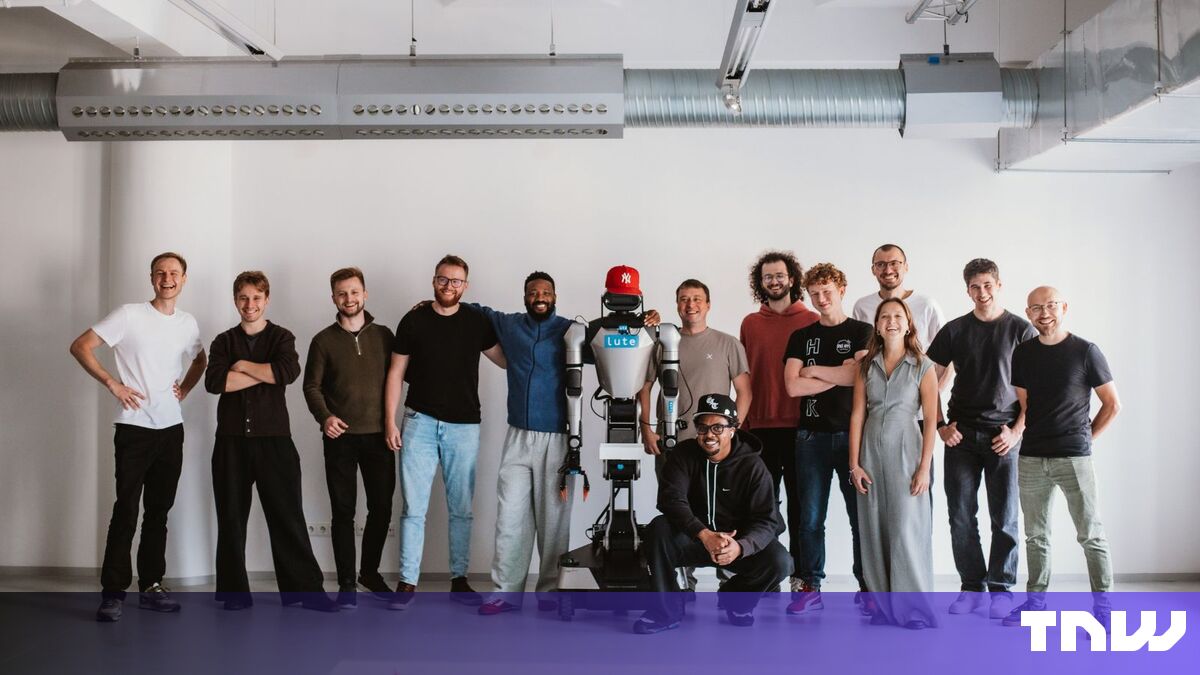
Lute, a Warsaw physical AI startup founded in January, has raised $20M to build robot models trained on touch. The pre-seed and seed money was announced on Tuesday. OTB Ventures and FORWARD.one co-led the seed round, and Credo Ventures and Seedcamp led the pre-seed. Inovo VC, Borusan Ventures, ff Venture Capital and angel investor Naval Ravikant also took part.
Lute will spend the money on touch data, model training and new customers. It is hiring in Warsaw and San Mateo, California.
Why touch
Most robots and physical AI models rely on cameras alone. Vision shows a robot where things are, Lute’s founders wrote. It does not show how firmly the robot holds an item, whether the item is slipping or how fragile it is.
“We believe touch is the missing signal that lets robots handle real work reliably,” chief executive Paweł Budzianowski said in a statement published by FORWARD.one.
With partners, Lute co-designed small, soft tactile sensors and built them into a portable rig. That lets it collect touch data anywhere. Zurich’s Enact is chasing the same idea, and raised $30M in October to give robots a sense of touch.
Lute-0 against π0.5
Lute also released its first model, Lute-0. It learns from video how a scene changes and turns that into robot movements. It is the first of a family of models Lute plans to train on touch as well as vision.
In Lute’s own retail tests, Lute-0 matched or beat π0.5, the open-source model from Physical Intelligence. It handled vegetables successfully 76% of the time, against 22% for π0.5. With soft snacks, the score was 98% against 70%. Lute says it also responds twice as fast. The figures come from Lute’s internal evaluation, and TNW has seen no independent results.
Lute says Lute-0 was pre-trained on far less data than π0.5, and trained much faster. Its two lead investors give different figures. It used about a twentieth of the data and a quarter of the training steps, OTB Ventures wrote. FORWARD.one puts it at about a tenth of the pre-training data.
Robots on real sites
Ten months in, Lute’s models already work at what it calls Europe’s largest automotive parts distributor. OTB puts that company’s annual revenue at $6bn. Lute also works on site with large retailers, and its models run in hospital corridors, according to OTB. The startup also partners with integrators, the firms that install robots for clients, starting with healthcare and manufacturing.
On site, the robots work on their own where they can, and a remote operator steps in when one needs help. They run unattended about 90% of the time, according to FORWARD.one. Failures and fixes then go back into training, so each deployment improves the next.
“In physical AI, the slow and the perfect will both lose,” said Boy de Jonge, investment manager at FORWARD.one.
Budzianowski has a machine learning PhD from Cambridge and led the machine learning team at PolyAI. He also co-founded K-Scale Labs, which built low-cost open-source humanoid robots. Co-founder Krzysztof Walas, the chief technology officer, was an associate professor at Poznań University of Technology and advised the Polish warehouse robotics company Nomagic. The team has 16 people in Warsaw and the Bay Area.