Making sense of USB-A and clearing up if it's becoming obsolete.
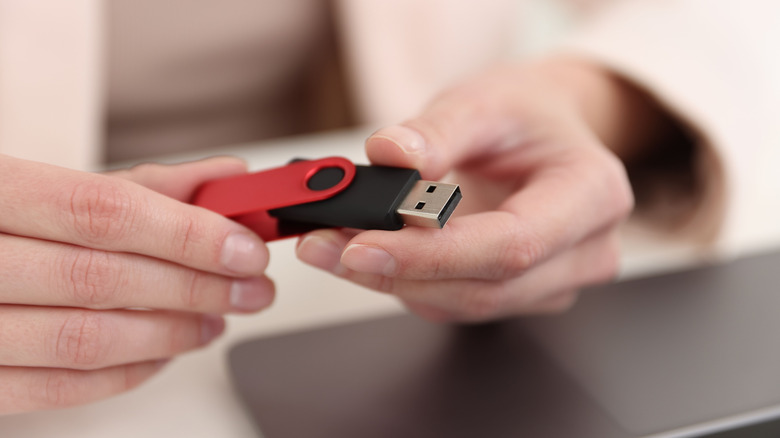
There's no hidden or extraordinary meaning for the letter "A" in USB-A. It's simply a letter designation for a Type-A connector, which is the familiar, wide rectangular plug found on flash drives and countless charging cables. USB itself stands for Universal Serial Bus, but the letter "A" identifies the connector type and nothing more. The same holds true for USB-B and USB-C connectors.
The reason for differentiating A, B and C goes back to the USB Implementers Forum (USB-IF) and the necessary designators for physical connections and power/data delivery. For instance, with a traditional printer, B is the square device connector and A is the rectangular end that plugs into your PC. In the early days, this was a simple method for informing consumers what goes where and why.
For everyday use, Type A is a connector label with charging capabilities or charging and data transfer. Sure, that's the boring way to describe it, but it really isn't anything beyond that. Alone, the USB-A designation doesn't tell you how quickly you can transfer files with it or how much charging power a USB-A port will spit out. At the end of the day, two ports with the same rectangular opening can represent two entirely different capabilities.
USB-A's shape doesn't reveal its speed
USB-A ports are reassuringly familiar to just about everyone, but the performance capabilities aren't readily apparent all the time. A USB 2.0 connection has a maximum data rate of 480 Mbps, but there are faster USB-A implementations that support 5 Gbps or 10 Gbps. Keep in mind that those are connection limitations that determine why a device may or may not function as expected when you plug it in. If you find a USB-A cable in a drawer, it may have a charging-only capability, or it could be capable of transferring data and charging devices. Without the associated labels and specs, it's just a USB-A cable with unknown capability.
Before you plug a USB-A into a PC port, check the cable's and the PC port's capabilities. There are usually markings beside each port (including a trident symbol), or you can find the information in the PC's manual. There are color differentiators as well, although most aren't universal. Instead, color choices are mostly up to manufacturers. A teal port usually indicates a faster USB connection, for example, but that is not a guarantee. If you're connecting a mouse or a keyboard, they usually don't need the kind of bandwidth that an external SSD will, so choose carefully.
For what it's worth, a USB 2.0 designation is not an automatic qualifier for USB-A only. Even a USB-C can be limited to USB 2.0. Separate the designator from the capability and carefully match them so you know what you have and what you can do.
Is USB-A becoming obsolete?
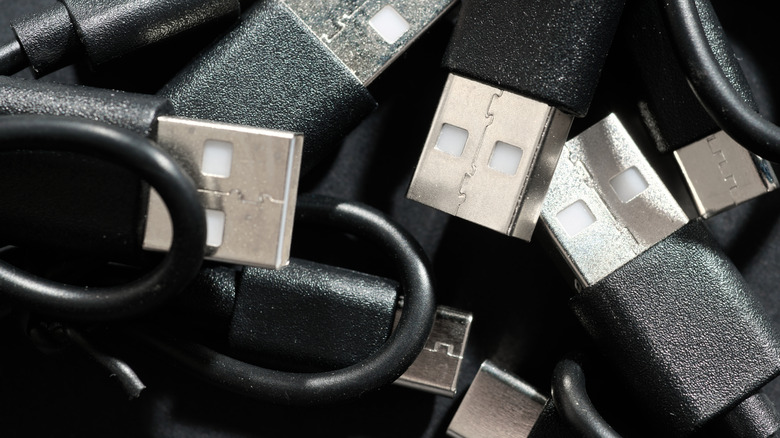
It's undeniable that USB-A is slowly giving way to USB-C, but that doesn't render USB-A useless. It hasn't gone the way of the rotary phone just yet. It's difficult to deny the shift, however, with most PCs, especially mid- and high-tier, shipping with more of a focus on USB-C ports. USB-C simply has practical advantages in several areas that make it a natural choice for today's devices, though it can be every bit as confusing as USB-A port colors. Most are reversible, feature a smaller connector for saving space on laptops, provide a connector platform for USB4 capabilities and are much more flexible in terms of size and usability.
Ultimately, there's no need for most people to replace a USB-A keyboard and mouse. You don't have to ditch your USB-A flash drive or forego USB-C to USB-A adapters. Granted, most mobile phones are now USB-C exclusive, except for adapters, of course. But PCs and Macs typically ship with USB-A ports, though they often play second fiddle to USB-C. All you need to do is choose the version that takes care of your needs. If you make a new purchase, base it on the ports you already have and use extensively. USB-A's declining presence is a good reason to become more flexible in terms of compatibility, but it's not a reason to get rid of usable devices and cables.