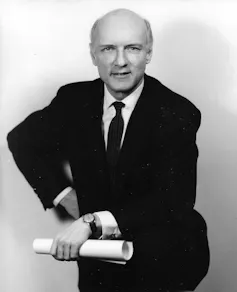
According to the late Heinz von Foerster, Friday, November 13 2026, is doomsday. Professor von Foerster and two colleagues at the University of Illinois published that prediction in 1960 in the respected journal Science. The paper has been widely discussed ever since.
Theirs was an unconventional vision of doomsday, brought about by the world’s population growing ever faster. Eventually, there would be an infinite number of people – literally, according to the paper. As von Foerster put it, his descendants would be “squeezed to death”.
Von Foerster deliberately engineered his analysis to make this outcome inevitable. He devised a mathematical equation that was predetermined to give the desired result and fitted it to human population data over the past two millennia to come up with a precise date. November 13 2026, would have been his 115th birthday.
The paper was von Foerster’s way of making the point that the rate of human population growth in 1960 was unsustainable. That conclusion was not new – it dates back to Thomas Malthus’s 18th-century Essay on the Principle of Population. The problem was von Foerster’s proposed solution: birth control on a massive scale.
What happened next
Others reached similar conclusions. In 1968, Paul Ehrlich, an American biologist and environmentalist, wrote his bestselling book The Population Bomb. He predicted mass famine. Four years later came The Limits to Growth, a report based on a computer model predicting systemic collapse by the 2020s as the growing population exhausted the planet’s resources.
These predictions turned out to be wildly wrong, but not before egregious harm was done in the name of saving the planet. During the 1970s, international agencies aggressively promoted birth control, even making it a condition of receiving food aid. Forced sterilisation programmes were introduced in south Asia. China’s one-child policy persisted until 2015.
All of these programmes were abandoned, yet the number of people aged under 15 in the world still peaked in 2021. Many countries are now concerned about their ageing populations.
Japan, Hungary, Turkey and even China are encouraging couples to have more children. This is as far as it could be from the future that von Foerster and like-minded population pessimists were imagining in the 1960s.
Five lessons
Some regard the doomsday paper as a historical curiosity to be regarded with indulgence. I disagree. I see it as a cautionary tale that undermines confidence in scientific predictions of all kinds. It should be cause to reflect on the merits of today’s prophecies of disaster.
Last month, a high-profile report identified 17 “major catastrophic threats”, two with “extinction potential” (nuclear war and malicious use of AI), and forecast their impacts to the year 2100.
If this type of exercise is really more credible than the population growth predictions, then the difference needs to be made plain. A good place to start is to take on board five lessons from von Foerster’s paper.
First, there is an uneasy relationship between science and advocacy. Science is about informing the debate; advocacy is about winning it. A favoured tool of the advocate is the worst-case scenario, and doomsday is the ultimate worst-case scenario. It is a rhetorical device rather than a serious scientific argument.
Second, exaggerating for effect is poor science and ultimately counterproductive. As studies of public attitudes to science have shown, people lose trust in scientists when they suspect them of overreaching.
Third, the doomsday equation illustrates a general principle: the way a model is constructed predetermines the possible outcomes. Von Foerster used this to his advantage and manufactured an eye-catching result. The same is true of many other predictions, though not usually so blatantly. No model of a complex system is exempt.
Fourth, claims to be “following the science” can discourage legitimate debate and direct attention away from the subjective choices scientists make when constructing their models. Those dire predictions of accelerating population growth were seen as incontrovertible at the time, and sceptics were accused of wilfully denying the disaster that would inevitably follow. That was pure hubris.
Fifth, ignoring inconvenient evidence will backfire, eventually. Von Foerster and the others failed to take into account that people living in richer, healthier and better-educated societies would have fewer children, to the extent that the decreasing birth rate outweighed the decreasing death rate.
This “demographic transition” was already under way by 1960 and it fatally undermined the population pessimists’ argument. Development was the answer to the population explosion.
A need for reflection
The latest doomsday will pass uneventfully, but there’s always another waiting round the corner – it’s a recurring theme of human history. Scientists may have taken the mantle from prophets and mystics, but are they really any better?
The “scientific” predictions of population growth of the 1960s and 70s proved no more reliable than the doom-mongering of Nostradamus. There are too many parallels between that episode and today’s predictions for any complacency.
Many of today’s scientists are genuinely and deeply worried about global threats (my own top concern is another pandemic). There is a wealth of scientific evidence and opinion underpinning those fears. Even so, it would be irresponsible to ignore the lessons of recent history and risk making the same mistakes again.
Friday, November 13 2026, is an opportunity for scientists to reflect that, when it comes to prediction, a little humility goes a long way. Anyone who interrogates predictions of catastrophe is doing due diligence, and good scientists should welcome it.