When scientists examine the brains of older people after death, what they find can often be puzzling. One such puzzle is that around a third of people who showed no signs of dementia when they were alive, had brains which contained key indicators of Alzheimer’s disease.
Neuroscientists describe these people as being “resilient” to Alzheimer’s. They see this trait as a good thing, and have spent decades trying to understand what makes a brain resilient.
The hope is that if we can find out, we may then be able to protect more people from the disease.
But coping with a disease isn’t the same as being protected from it. A brain that copes well may also be hiding the disease – sometimes until it’s too late to act.
Hiding disease
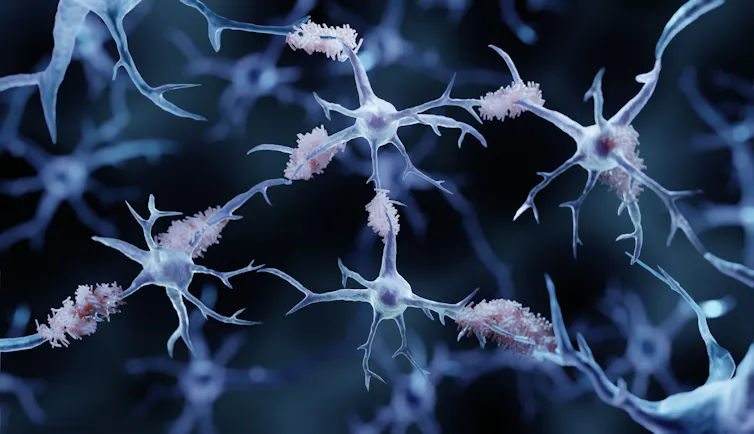
Alzheimer’s disease unfolds in stages. First, proteins called amyloid and tau build up in the brain as plaques and clumps known as “tangles”. Then the brain cells (neurons) are damaged and die. Finally, memory and thinking begin to fail.
Some people never accumulate much amyloid or tau despite having a high genetic risk of Alzheimer’s disease. Researchers call this “resistance”.
Others experience a build up of amyloid and tau, but cope with it. This is resilience.
There are two key forms of resilience. In the first, someone may have plenty of amyloid and tau in the brain but they don’t lose many brain cells.
In the second form, this amyloid and tau build-up does result in the loss of brain cells – but the person may still continue thinking clearly. Or, if there is cognitive decline, it’s very slow – so symptoms are less noticeable.
This second form of resilience should worry us most, because a person can seem perfectly well while their brain is quietly shrinking.
This situation is often seen in women. On average, women have better verbal memory than men throughout life, meaning they have better recall of language-based information such as words, names and stories.
But this can be a problem when identifying Alzheimer’s, as the memory tests used to diagnose the disease rely heavily on verbal memory. Research has even found that women with signs of Alzheimer’s scored better on memory tests than men who had similar signs of the disease.
Read more: Dementia: how brain resilience, immune health and the menopause play a role in women’s risk
A similar pattern is also seen in people with high “cognitive reserve”. Cognitive reserve is the brain’s ability to adapt and improvise when it faces a setback – such as those caused by ageing or disease. Cognitive reserve is built throughout life by things such as education and mentally demanding work.
People with high cognitive reserve tend to develop Alzheimer’s symptoms later. But once symptoms do appear, brain function tends to decline more quickly. This is usually because by the time symptoms develop the disease is already quite far along.
So although resilience can protect a person’s cognitive health for years, the disease eventually outpaces the brain’s ability to cope. The resilience that was once beneficial to us is suddenly no longer helpful.
This can be a problem for several reasons.
The first problem is that it can delay diagnosis. This means a person won’t get the support they need at a crucial stage.
Another problem with resilience is that if it hides the disease until it’s in its advanced stages, people may miss the window for when treatment could help most. The only drugs currently approved to slow the progression of Alzheimer’s must be taken in the early stages of the disease to potentially have any effect.
Resilience can also make it difficult when researching and testing new Alzheimer’s drugs. People who cope well decline slowly overall – whether they receive a drug or a placebo. This could make a drug look weaker or stronger than it might actually be. It may also be one of the reasons why a drug may not work equally well for all people who have Alzheimer’s disease.
For example, one Alzheimer’s drug was found to be more effective in people who were less resilient. For people who were highly resilient (even though they had high levels of tau in their brain and similar cognition as the less resilient people), there wasn’t a clear benefit.
Understanding resilience
There’s still much scientists don’t know about resilience.
Although genetics can provide some information about a person’s Alzheimer’s risk and the disease’s likely progression, it unfortunately can’t tell us very much about resilience.
We still need to figure out what’s happening in the brains of people who stay well, and what exactly changes in the brain when that protection starts to fail.
But ongoing research may help us answer these questions someday. Biomarkers, which are measurable signs of a disease, can detect Alzheimer’s from a blood sample. If paired with a cognitive test, this could let researchers see how much disease a person carries, how much damage it’s doing and how well a person’s cognitive function has held up.
Biomarkers could also improve research for treatments by showing which interventions really have an effect in slowing the disease or making people resilient or even resistant.
When it comes to Alzheimer’s, resilience shows us that carrying the disease doesn’t have to mean losing your memory or your independence. But it can also hide signs of the disease until it’s too late.
Uncovering the biology behind resilience could allow us to offer protection to those who need it – and intervene earlier for those who are highly resilient.